
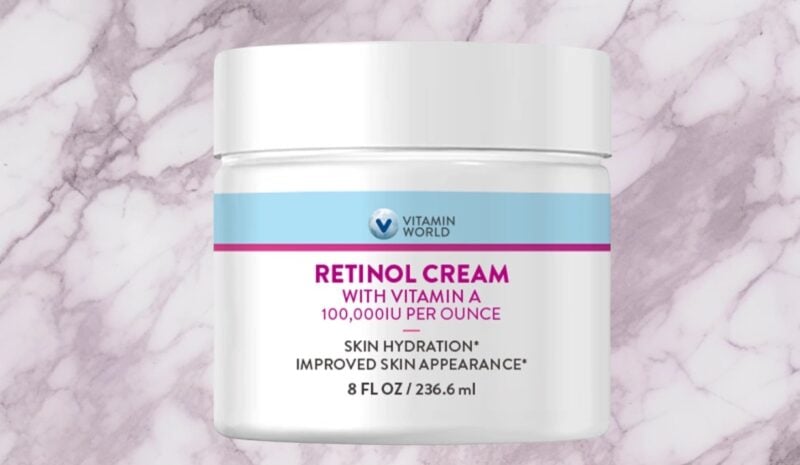
Don’t you just hate it when brands proudly proclaims their serums and creams are full of retinol and then when you look at the ingredient list, it’s nowhere to be found. WTH?! Case in point, Vitamin World Retinol Cream states on the jar (starting to see problems already?!) “Retinol Cream with Vitamin A 100,000IU Per Ounce,” which makes you think this must be one of the best retinol creams ever. Except… In this Vitamin World Retinol Cream review, I’ll set the record straight on all the issues with this cream and whether it’s really the best option for retinol beginners or anyone with sensitive skin.
- Key Ingredients in Vitamin World Retinol Cream: What Makes It Work?
- The Rest Of The Formula & Ingredients
- Texture
- Fragrance
- How To Use It
- Packaging
- Performance & Personal Opinion
- What I Like About Vitamin World Retinol Cream
- What I DON’T Like About Vitamin World Retinol Cream
- Who Should Use This?
- Does Vitamin World Retinol Cream Live Up To Its Claims?
- Price & Availability
- The Verdict: Should You Buy It?
Key Ingredients in Vitamin World Retinol Cream: What Makes It Work?
COCONUT OIL
You know coconut oil. It’s been in everything from your gran’s kitchen to your 2015 DIY face mask phase. In this cream it’s working as an emollient and occlusive, so it softens skin and puts a light seal on it to slow down water loss. A randomised controlled trial found it was just as good as mineral oil at improving hydration and reducing water loss in people with eczema. But here’s what nobody puts on the jar: coconut oil is one of the most comedogenic ingredients in skincare. If your skin breaks out easily, this cream might be the reason you’re waking up with new spots. Dry skin that never clogs? Probably fine. Oily, acne-prone, combo skin? This is already a red flag.
MINERAL OIL
Mineral oil has spent decades getting absolutely dragged on the internet by people who read “petroleum byproduct” and didn’t bother reading any further. Cosmetic-grade mineral oil is heavily refined, has a rock solid safety record, and is honestly one of the most well-studied ingredients in the whole industry. What’s it doing here? It’s an occlusive. It sits on the surface of your skin and stops water evaporating off it. It doesn’t sink in, it doesn’t add moisture itself, it just keeps what’s already there from disappearing. A review in the Journal of Cosmetic Dermatology confirmed it’s non-comedogenic and non-sensitising – the whole “it clogs your pores” thing is basically a myth that refuses to die. The only legitimate gripe with mineral oil is how it feels. It’s heavy. If you’re oily or you live somewhere humid, you might absolutely hate it on your skin.
Related: 7 Myths About Mineral Oil You Need To Stop Believing Right Now
RETINYL PALMITATE
Okay this is the one. This is the ingredient the whole product is built around. Retinyl palmitate is a retinoid. It is technically a derivative of Vitamin A. The label isn’t lying. But calling this a retinol cream because it contains retinyl palmitate is like calling a flat white a shot of espresso because there’s espresso in it. Technically connected. Not the same thing.
Here’s the problem. Before retinyl palmitate can do anything useful in your skin, it has to be converted. First into retinol, then into retinaldehyde, then finally into retinoic acid – which is the form that actually binds to your skin cell receptors and does the stuff you actually want: cell turnover, collagen, fading uneven tone. That’s two full conversion steps just to reach retinol level, never mind the active form. And potency drops at every single step. Retinyl palmitate is significantly weaker than retinol, which is itself weaker than prescription retinoic acid.
Totally useless though? Not quite. If your skin is so reactive it can’t handle real retinol without peeling and going red, retinyl palmitate is much gentler and that’s a real benefit for some people. But if you’re buying this expecting retinol results, this isn’t it.
The Rest Of The Formula & Ingredients
NOTE: The colours indicate the effectiveness of an ingredient. It is ILLEGAL to put toxic and harmful ingredients in skincare products.
- Green: It’s effective, proven to work, and helps the product do the best possible job for your skin.
- Yellow: There’s not much proof it works (at least, yet).
- Red: What is this doing here?!
- Aqua (Deionized Water): It’s water, basically. Purified so it doesn’t mess with the other ingredients. It dissolves all other ingredients.
- Propylene Glycol): A humectant, so it draws water into your skin. It also helps other ingredients absorb and keeps the formula from going weird.
- Glyceryl Stearate SE: This is what stops the water and oils from separating into a mess. An emulsifier, basically.
- Stearic Acid: A fatty acid that helps keep the emulsion stable and adds a bit of softness to skin. It also contributes to why this feels like a proper thick cream.
- Cetyl Esters: A waxy thickener that gives the cream its body and that smooth feel when you apply it. Mild emollient properties too.
- Diazolidinyl Urea: A preservative that stops bacteria and mould growing in your cream, which you want. It works by releasing tiny amounts of formaldehyde, which sounds worse than it is at cosmetic concentrations. It is though one of the more likely preservatives to cause reactions in sensitive skin.
- Methyl Paraben: Another preservative, probably the most studied cosmetic ingredient ever. Safe at these concentrations, the bad reputation came from one badly interpreted study and the panic just never died down.
- Propyl Paraben: Works with methyl paraben to cover more microbial bases. Together they protect against a wider range of things that could grow in here.
- Isopropyl Myristate: Makes the formula feel less greasy and heavy, which given everything else in here it’s probably working overtime on. Also helps other ingredients sink in better. Moderately comedogenic though, so combined with the coconut oil, this formula is really not for acne-prone skin.
- Triethanolamine: pH adjuster. Keeps the formula at the right acidity level so it doesn’t irritate your skin and everything stays stable.
- Cetyl Alcohol: Not the drying kind of alcohol, fatty alcohols are completely different. This one thickens the cream, makes it feel smooth, and helps hold the emulsion together.
- Dimethicone: A silicone that gives that immediately smooth feeling when you apply something and makes the appearance of fine lines look smaller.
- Tocopheryl Acetate (Vitamin E): The stable version of vitamin E, it’s mainly here as an antioxidant to protect the formula from going off and to offer a bit of antioxidant protection on skin.
- Tetrasodium EDTA: Binds to metal ions in the formula that would otherwise mess with the preservatives and destabilise everything.
- Parfum (Fragrance): It’s here so the cream smells nice. Fragrance is one of the most common causes of skin reactions and irritation in cosmetics.
- Tocopherol (Vitamin E): This is the active unconverted form of vitamin E, so more potent on skin than the acetate version but less stable in the formula. It keeps everything else stable.
- D&C Yellow #10: A dye. Makes the cream look a certain colour.
Texture
This is a thick, rich cream, the kind that sits heavily on skin and takes a while to sink in. It’s not a lightweight moisturiser by any stretch, and if you run oily or combination you’ll probably find it too much. It doesn’t feel silky or modern in the way newer formulas do. It’s old-school, dense, and very much a coat-your-skin-in-moisture kind of texture.
Fragrance
The fragrance is noticeable. It’s not overwhelming but it’s there, which is worth flagging if you have sensitive skin or you’re trying to keep your skincare routine fragrance-free (and you should!).
How To Use It
The brand recommends applying a small amount to face and eye area at bedtime after cleansing, which is the right call given the texture. Now, normally with a retinol treatment, I’d say start slow, use it every two to three nights, let your skin adjust before building up frequency. But here’s the thing, this doesn’t actually contain retinol. It contains retinyl palmitate, which is the weakest form of vitamin A and unlikely to cause the irritation or purging you’d associate with real retinoids. So the usual cautious retinol introduction rules don’t really apply here. You could use it nightly without the same concerns – though that’s not going to give you better results in the anti-aging department.
Packaging
It comes in a jar, which is already a problem. Retinyl palmitate is unstable and it degrades when exposed to light and air/. A jar means every time you open it you’re exposing the whole product to both. A pump or an opaque tube would protect the formula far better, although it may be tricky to get such a heavy formula out of it.
Performance & Personal Opinion
Honestly? This cream moisturises. I’ll give it that. Skin feels soft and hydrated after use, and if that’s all you’re asking of it, it delivers. But beyond that? Nothing. No visible improvement in skin tone, no noticeable change in texture over time, no reduction in fine lines. And it absolutely does nothing for dark spots. If you’re buying this because you want retinol results (fewer lines, better texture, more even skin tone, brighter complexion), you’re going to be waiting a long time. It’s the sort of cream that feels pleasant enough in the moment and then you realise you’ve been moisturising in a slightly expensive way and calling it anti-ageing skincare. Fine as a basic moisturiser. Deeply disappointing as anything else.
What I Like About Vitamin World Retinol Cream
- Moisturises well, skin feels soft and comfortable the next morning
- Helps repair your skin barrier
- Banishes rough texture and dry skin
What I DON’T Like About Vitamin World Retinol Cream
- It calls itself a retinol cream but contains retinyl palmitate, the weakest retinoid on the entire ladder, not retinol
- Contains a high concentration of comedogenic ingredients
- Heavy texture, may feel greasy
- Fragrance may irritate sensitive skin
- Jar packaging actively degrades the stability of the very ingredient this product is built around
- No real anti-ageing results to speak of beyond basic moisturisation
- Won’t give you a clearer complexion or fade away dark spots
Who Should Use This?
If you have dry, non-acne-prone skin, you’re not bothered about retinoid results, and you just want a rich, affordable moisturiser that keeps skin feeling comfortable, this works for that. But that’s about where the suitable audience ends. If you have any other skin type (oily skin, combination skin, acne-prone skin…), this isn’t the right product.
Does Vitamin World Retinol Cream Live Up To Its Claims?
| CLAIM | TRUE? |
|---|---|
| At night, Retinol Cream goes to work, revitalizing and hydrating your skin. | The way this is worded, it’s very misleading. It makes you think it does more than it does. It’s true that it hydrates skin. Revitalising skin means nothing. And the retinol in the name makes you think this is more anti-aging than it really is. |
| Retinol Cream helps reduce the appearance of fine lines and wrinkles and can help set damaged skin on a healthier course. | Again, this is misleading. It’s true that helps reduce the appearance of fine lines and wrinkles… through moisturisation! When skin is very hydrated, it looks plumper, and that in turns, make wrinkles look smaller. It has nothing to do with retinol (which isn’t even here!) |
Price & Availability
$28.99 at Walmart
The Verdict: Should You Buy It?
If you want a retinol cream, this isn’t it. The name is misleading, the hero ingredient is the weakest form of vitamin A available, and the results reflect that. There are proper retinol products or even better retinol alternatives at accessible price points that will do what this one implies it’s doing, and you’re better off with one of those. If you want a basic, affordable, rich moisturiser and you’re not expecting anything beyond soft, hydrated skin, it does that job fine.
Ingredients:
Aqua (Deionized Water), Cocos Nucifera (Coconut) Oil, Propylene Glycol, Glyceryl Stearate SE, Mineral Oil, Stearic Acid, Cetyl Esters, Diazolidinyl Urea, Methyl Paraben, Propyl Paraben, Isopropyl Myristate, Triethanolamine, Cetyl Alcohol, Dimethicone, Retinyl Palmitate (Vitamin A)†, Tocopheryl Acetate (Vitamin E), Tetrasodium EDTA, Parfum (Fragrance), Tocopherol (Vitamin E), D&C Yellow #10.
†Providing Retinol.