
Last Updated on December 4, 2025 by Giorgia Guazzarotti
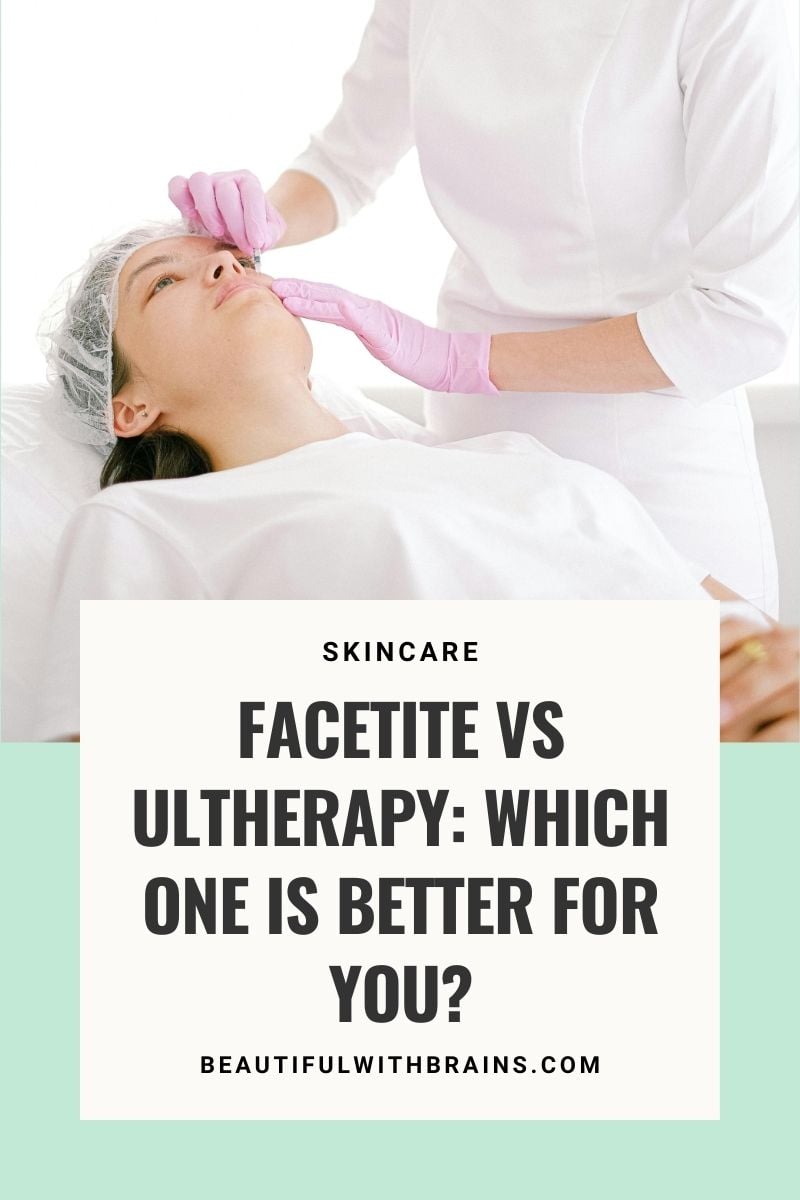
Look, I’m gonna be straight with you. If you’re sitting there googling “FaceTite vs Ultherapy” at 2am because you’ve noticed your jawline isn’t quite where it used to be, I get it. The whole non-surgical skin tightening world is confusing as hell, and honestly? A lot of the information out there reads like it was written by robots. So let me break this down for you in actual human terms, because I’ve spent way too many hours digging through scientific studies (yes, the boring peer-reviewed kind) to figure out what’s actually going on with these treatments. In this breakdown, you’ll read what they are, what they do, and which of these effective treatments is better for your unique skin type and concerns.
Facetite VS Ultherapy: What Are They?
Here’s the deal: both FaceTite and Ultherapy are trying to solve the same problem: loose skin, sagging jowls, that lovely double chin that appeared out of nowhere. But they’re taking completely different routes to get there.
Ultherapy is the completely non-invasive option. Like, zero cutting involved. It uses ultrasound waves (yep, similar technology to what they use to look at babies in utero, but cranked up) to heat up the deep layers of your skin. The ultrasound energy creates these tiny thermal injury zones on the treatment area that trigger your body’s natural healing response and kick collagen production into high gear.
FaceTite is what they call minimally invasive. There ARE small incisions involved (don’t freak out, we’re talking tiny), and they actually insert a probe under your skin. It uses radiofrequency energy (basically controlled heat) delivered from both under and on top of your skin simultaneously. This is radiofrequency-assisted lipolysis if you want to get technical about it, which means it’s melting fat AND tightening skin at the same time.
Struggling to put together a skincare routine that minimises wrinkles, prevents premature aging, and gives your complexion a youthful glow? Download your FREE “Best Anti-Aging Skincare Routine” to get started (it features product recommendations + right application order):
How Do They Work?
Okay, so here’s where it gets interesting. Both treatments are all about collagen production, right? Because collagen is basically the scaffolding that keeps your face from sliding down toward your knees as you age.
With the Ultherapy treatment, the ultrasound technology creates these super precise thermal coagulation points at specific depths: 1.5mm, 3.0mm, and 4.5mm deep. They heat the tissue to somewhere between 60-70°C (that’s HOT), which causes immediate collagen contraction. But here’s the cool part: recent studies from 2024 actually confirmed that it’s not just creating new collagen. It’s also regenerating elastin fibers. That’s the stuff that makes your skin bouncy and elastic. So it’s doing double duty.
FaceTite works differently. The radiofrequency device heats tissue to a lower temperature (around 38-42°C), but because there’s a probe actually UNDER your skin (with an external electrode on top), it’s heating from both directions. This creates more uniform heating of your skin and the underlying fat layer. The studies on this show tissue contraction of up to 34% over 12 months. Compare that to regular liposuction without the RF energy, which only gives about 6% contraction. That’s a massive difference.
What Actually Happens During Each Treatment
THE ULTHERAPY PROCEDURE
Okay so you show up, and there’s basically no prep needed. The whole thing takes 30-90 minutes depending on how many areas you’re treating. Most people don’t get any anesthesia, which honestly… is where things get real. Because I’m not gonna sugarcoat what everyone’s thinking: Ultherapy can HURT. Like, properly hurt. But here’s the trade-off: it’s an excellent option if you just want to walk out and go straight back to work. No recovery time, maybe some redness for a few hours. That’s it. It’s a non-invasive treatment in the truest sense.
THE FACETITE PROCEDURE
This one requires local anesthesia, so you’re numbed up properly. Your plastic surgeon or cosmetic surgeon makes these tiny incisions (seriously, they’re small – think needle-sized) and inserts this thin cannula under your skin. The whole thing takes 1-2 hours. The dual benefit here is that while the radiofrequency waves are tightening your skin, they’re also liquefying fat cells that then get suctioned out. So if you’ve got unwanted fat deposits along with skin laxity, this is addressing both issues at once. Recovery? You’re looking at 3-7 days of downtime. There will be swelling and bruising. You’ll need to wear a compression garment for a bit. Most people can go back to work after a few days, but you’re supposed to avoid strenuous stuff for about two weeks.
Related: Does Ultherapy Hurt? (And What To Do About It)
Who Are The Best Candidates For These Treatments?
This is where it gets personal, because the best option really depends on what’s going on with YOUR face.
You might be a better candidate for Ultherapy if:
- You’ve got mild to moderate skin laxity (not severe sagging)
- You don’t have excess fat to deal with
- You absolutely cannot afford ANY downtime
- You want to treat areas beyond just the lower face (it works on the entire face, neck, décolletage, even brows)
- The idea of a small incision freaks you out
- You’re okay with more subtle, gradual results
You might be better suited for FaceTite if:
- You’ve got moderate to more significant sagging happening
- You’ve got fat deposits along with loose skin (hello, jowls and double chin)
- You can take a week off for recovery
- You want more dramatic results from a single treatment
- You’re specifically concerned about the lower half of the face (jawline, chin, neck area)
- You want longer-lasting results and don’t want to come back every year
How Long Do Results Last?
This is where things get REALLY different.
Ultherapy results are gradual. You won’t walk out looking different. The collagen remodeling process takes time: you’ll start seeing changes around 2-3 months, with maximum results at 3-6 months. Most people get 1-2 years out of a treatment, though the research shows some people maintain improvements up to 18 months or longer. But generally? You’re looking at annual treatments to maintain things.
FaceTite results show up faster – some people see immediate tightening, and about 70% of your final results show up within 6 weeks. But then it keeps improving as new collagen forms, with best results at 6 months to a year. The big difference? These results last 3-5 years, sometimes longer. Most people only need ONE treatment session. So yeah, FaceTite costs more upfront, but when you factor in Ultherapy needing repeated sessions… the math gets interesting. The cost of FaceTite might actually be better value long-term as it gives you more long-lasting results.
Facetite VS Ultherapy Side Effects
As non-invasive procedure, Ultherapy side effects are generally minimal: redness, slight swelling, maybe some tenderness. Some people get temporary numbness or tingling. The procedure itself is the hard part (pain-wise), not the recovery.
FaceTite comes with typical minimally invasive procedure stuff: bruising, swelling, soreness, numbness that usually resolves within a week. There’s a tiny risk of infection (anytime you make an incision, there’s that risk), and you might have some temporary firmness or irregular texture while things heal.
Can You Combine Them? (Spoiler: Yes)
Here’s something that doesn’t get talked about enough: you’re not locked into picking just one treatment. A lot of plastic surgeons actually use different technologies for different areas of your face. The most common combo approach? Ultherapy for the upper face (brows, forehead, around the eyes) and FaceTite for the lower face and neck. It makes sense when you think about it. The upper face usually doesn’t have the fat deposits that FaceTite targets, while the lower face and neck benefit from both the fat reduction AND skin tightening that radiofrequency-assisted lipolysis provides.
FaceTite also gets paired with surface RF treatments like Morpheus8 sometimes. FaceTite works deep under the skin while surface treatments handle texture and fine lines on top. You’re basically attacking the problem from multiple angles. Some people also use these strategically over time. Maybe you start with Ultherapy in your early 40s for subtle maintenance, then move to FaceTite later when you need more aggressive intervention. Or you do FaceTite as your main treatment, then use Ultherapy for touch-ups years later since it has zero downtime.
The key is finding a cosmetic surgeon who offers MULTIPLE options and will honestly assess what combination (if any) makes sense for YOUR face and youthful skin goals, not just upsell you on every treatment they offer. Your treatment plan should be customized to your specific needs and aesthetic goals, period.
What You Should Actually Do
Book a consultation with a board-certified plastic surgeon or experienced cosmetic surgeon who offers BOTH treatments. Anyone who only offers one and pushes that as the best option for everyone? Red flag. You want someone who’ll honestly assess your skin, your concerns, and recommend what’ll actually give you the best results for YOUR face and unique needs. Ask about their experience, look at before and after photos, ask about their complication rates. And be honest about your expectations, your tolerance for downtime, and your budget. Because at the end of the day, the goal is a more youthful appearance and natural-looking results that make you feel good when you look in the mirror – whether that comes from ultrasound energy, radiofrequency energy, or some combination of cosmetic treatments.
The Bottom Line
If you want my honest take after reading through all this research:
Choose Ultherapy if you’ve got mild sagging, want an entirely non-invasive option, can’t afford any downtime, and are okay with maintenance treatments. It’s a solid non-surgical treatment with tons of scientific backing.
Choose FaceTite if you’ve got moderate to significant loose skin, especially in the lower face and neck, you’ve got some excess fat you want gone, you can handle a week of recovery, and you want longer-lasting, more dramatic results from one treatment session.
Neither is objectively “better.” They’re just different non-surgical options for different situations. FaceTite is closer to plastic surgery territory (though still minimally invasive), while Ultherapy is as non-invasive as skin tightening gets. And look, neither of these is going to give you a facelift. If you’ve got severe sagging, significant excess skin, or really advanced aging concerns, invasive surgery might actually be the most appropriate option. These non-surgical procedures are for people in that middle ground: past what topical products can fix, but not quite ready for (or needing) facelift surgery.