
Last Updated on October 5, 2026 by Giorgia Guazzarotti

I learned the hard way you don’t want alcohol in your skincare. I was a beauty-obsessed 15-years old with no idea on how to put a skincare routine together. I just bought what Cioé magazine recommended, including a toner loaded with alcohol. Only, I didn’t know it was loaded with alcohol. I just knew my skin got as dry as the Sahara and I couldn’t figure out why. Only when I ditched toners for good (turns out, you don’t even need one!), finally went back to normal.
Once I figured out the culprit, I started looking for alcohol-free skincare products. But, wait, what’s that?! When I checked the label, alcohol had somehow sneaked its way in there, too. How could these brands break the rules like this? They weren’t. You see, there are two types of alcohol: bad alcohols that should have you run in the opposite direction and fatty alcohols that keeps your skin soft and smooth.
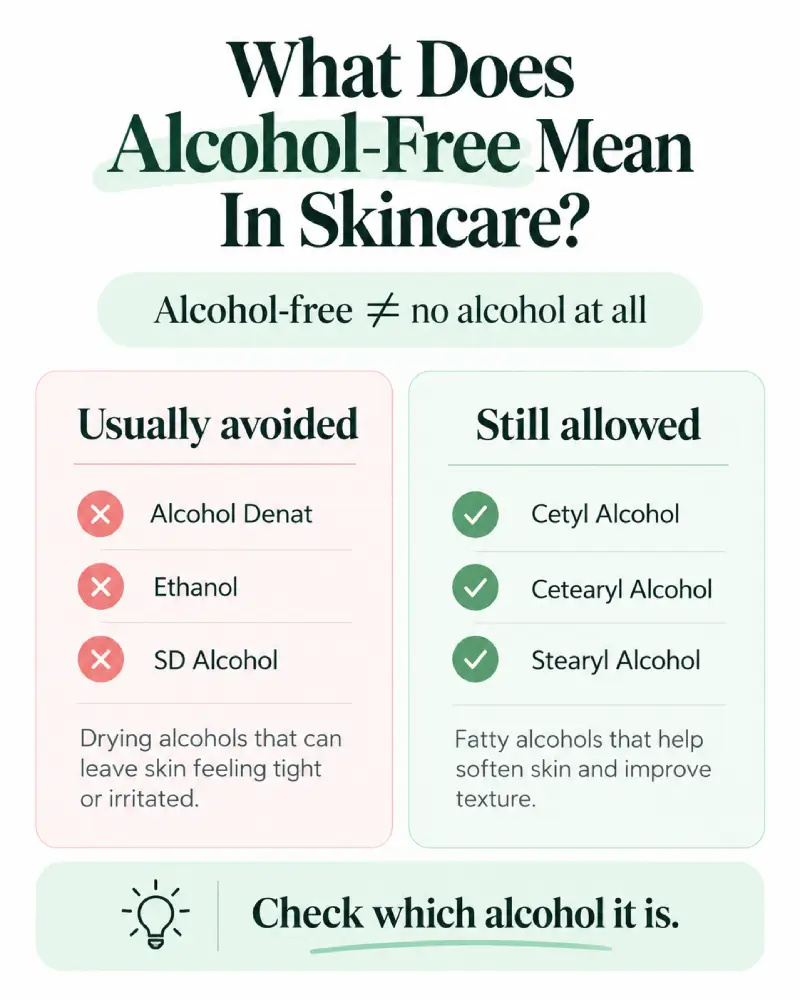
Alcohol-free skincare doesn’t necessarily contain zero alcohols. It usually means the formula doesn’t contain ethanol/ethyl alcohol, including denatured alcohol. Fatty alcohols such as cetyl, cetearyl and stearyl alcohol can still be there because they’re good for skin. Here’s what alcohol-free means in skincare and what you should be looking for when you go shopping:
What Does Alcohol-Free In Skincare Really Mean?
Let’s rewind back to when I was scrutinizing skincare labels to avoid anything with a drop of alcohol in it. I’d pick up a bottle labelled alcohol-free and then realise it had cetyl alcohol or butylene glycol. Surely, this was against the law?
Nope. If a skincare product says “alcohol-free,” it doesn’t mean it contains no ingredients with the word alcohol in their name. In skincare, alcohol-free usually means the formula doesn’t contain drying alcohols like ethanol, alcohol denat or SD alcohol. Fatty alcohols like cetyl alcohol, cetearyl alcohol and stearyl alcohol can still be in the formula.
The first kind dries out your skin and may even cause irritation. The second is actually moisturising, so it wouldn’t be fair to paint the goodies with the same brush as the baddies. Mystery solved! So now let’s take a look at these different types of alcohol, so you know how to spot the bad boys and avoid them.
| TYPE | COMMON NAMES | WHAT IT DOES |
|---|---|---|
| Drying alcohol | Alcohol Denat, Ethanol, Ethyl Alcohol, SD Alcohol | Solvent, lightweight texture, penetration enhancer |
| Fatty alcohol | Cetyl Alcohol, Cetearyl Alcohol, Stearyl Alcohol, Myristyl Alcohol | Emollient, thickener, emulsifier |
Drying Alcohols: What Does It Do In Skincare?
This type of alcohol is like a solvent:
- It thins thick formulas (it’s usually what gives chemical sunscreens their super lightweight textures)
- It helps deliver skincare actives deeper into your skin
- It gives skin a tight feeling and constricts the pores (it’s way they’re so common in products for oily skin)
These alcohols seem innocuous enough, don’t they? But that tight feeling is a sign of dehydration. Alcohol eats up your skin’s protective barrier, leaving your skin dry and irritated. That’s also how they help other ingredients better penetrate your skin, by the way. Once this barrier is damaged, everything can get through it.
FYI, the latest research shows you can counteract the drying effects of alcohol with a good moisturiser. As long as that toner or cream you’re eyeing also has moisturising ingredients, you’re probably going to be fine. It’s when you use too much alcohol (like those alcohol-laden toners for teens) that problems start.
How Do You Identify Drying Alcohols On The Ingredient List?
Look out for these bad boys:
- Alcohol Denat
- Benzyl Alcohol
- Ethanol
- Ethyl Alcohol
- Isopropyl Alcohol
- Methanol
- SD Alcohol.
If they’re low on the ingredient list, you’re cool. If they’re high, check if the product also has moisturising ingredients, like ceramides or natural oils. If it doesn’t, or your skin is particularly sensitive, leave it on the shelf.
Fatty Alcohols: What Do They Do In Skincare?
This type of alcohol is called fatty alcohol. It’s the complete opposite of his bad sibling. If the latter is drying, good alcohols are moisturizing:
- They’re thickeners (they’re what gives body butters their rich texture)
- They have emollient properties that moisturize your skin, leaving it softer and smoother
- They oils and water mix together, so your skincare products don’t separate into two gooey layers
How Do You Identify Them On The Label?
The main fatty acids used in skincare are:
- Behenyl Alcohol
- Cetearyl Alcohol
- Cetyl Alcohol
- Myristyl Alcohol
- Stearyl Alcohol
There are other alcohols that aren’t fatty but are still very hydrating:
- Butylene glycol
- Propanediol
These are friends for your complexion. Don’t be scared of them.
FAQs
I’m Already Using A Product With Alcohol Denat High On The List. Should I Throw It Away?
Look at your skin. Is it red? Flaky? Does it sting when you put stuff on? Then yeah, bin it. I don’t care if it cost you fifty quid. But if your skin actually seems okay and the product has other good stuff in it like glycerin or hyaluronic acid, just finish it. Use a proper moisturizer after and you’ll probably be fine. When it runs out though, get something else. Don’t buy it again. That’s the main thing. And if halfway through the bottle your skin starts getting annoyed, stop. Don’t be stubborn about it like I was with those stupid toners when I was 15. I kept using them even though my skin was basically turning into sandpaper because I thought that was just how my skin was. It wasn’t. It was the toner being horrible.
Are “Alcohol-Free” Claims Regulated?
No. They can basically write whatever they want on the front of the bottle. Alcohol-free just means no alcohol denat or ethanol, the drying ones. They can stuff it full of cetyl alcohol and all those fatty alcohols and still call it alcohol-free. Which is actually fine because those ones are good, but nobody tells you that so everyone gets confused. The beauty industry is kind of a mess when it comes to labeling. They know most people won’t flip the bottle over and read the ingredients. They know we’ll just believe whatever is written on the front in big letters. So they use that. It’s sneaky but it’s not technically illegal. This is why I’m always banging on about reading ingredient lists. The front of the package is marketing. The back is what’s actually in there.
What Should I Look For Instead Of Alcohol-Based Toners?
Frankly, you don’t need a toner at all. But if you want to use one, look for hydrating ingredients like glycerin, hyaluronic acid, and panthenol. Those fatty alcohols are good too – cetyl alcohol, cetearyl alcohol. If your skin freaks out easily, niacinamide or centella are nice. The main thing is it shouldn’t make your face feel tight or tingly. I know some people think that burning sensation means it’s working but it really doesn’t. It means it’s irritating your skin. A good toner just feels like water, maybe slightly thicker. It doesn’t feel like anything dramatic. It’s not supposed to. Your skin shouldn’t feel squeaky clean or tight after using it. That tight feeling is dehydration. That’s bad. You want your skin to feel soft and maybe a bit damp, that’s it.
Does The Percentage Of Alcohol Matter?
Yeah but you can’t see the percentage, you have to guess from where it sits in the ingredient list. If alcohol denat is in the top five ingredients, there’s loads of it. Bad. If it’s near the bottom with all the random preservatives, there’s probably not much. Better. The higher up it is, the more there is. That’s how ingredient lists work. And even if there’s only a tiny bit in one product, if you’re using a bunch of products that all have a bit of alcohol in them, it adds up. You end up drowning your skin in alcohol without meaning to. I see people with like five products in their routine and they’re all alcohol-heavy and then they wonder why their skin is a mess. Well, you’re basically pickling your face. That’s why.
Can Alcohol Cause Acne Or Make It Worse?
Oh god yes. It’s so annoying because it tricks you at first. You use an alcohol toner, it dries everything up, kills some bacteria, your spots look better for a bit. Then your skin panics because it’s too dry and starts making MORE oil to compensate. So you get even oilier than before. Plus your skin barrier is broken now so bacteria gets in easier and causes more spots. And your skin is inflamed from being irritated constantly. Inflammation causes acne. So you’re making it worse while thinking you’re making it better. It’s a trap. People get stuck using these alcohol products for years thinking they’re the only thing keeping their acne under control when really they’re causing half the problem. Use actual acne treatments instead. Salicylic acid, niacinamide, benzoyl peroxide. Things that actually work without wrecking your skin.
The Bottom Line
Look, alcohol-free just means no alcohol denat or ethanol, the drying ones. Fatty alcohols are totally allowed and they’re fine, they’re actually good for you. Stop panicking when you see cetyl alcohol on the label. The brands aren’t lying to you, they’re just counting on you not knowing there are different types of alcohol. Learn to read the ingredient list instead of trusting whatever crap they write on the front. If you see alcohol denat near the top and your skin is sensitive or dry, don’t buy it. If it’s at the bottom or there’s loads of moisturizing stuff in there too, you’re probably okay. Once you get this down, buying skincare gets way less stressful because you actually know what you’re looking at.
ahh now I got it 🙂 thanks
alcohol just good for my oily skin 🙂
I prefer my products to be alcohol free. My skin tends to be on the dry side.
Very informative post! Thank you very much for this 🙂
eeep! all the while i tot alcohol was only bad! 😀 informative indeed.
Nikki and Cyndi: you’re both very welcome 🙂
My Makeup Mania: some alcohols can help degrease oily skin but be careful not to ovedo it as that could dy out your face too much.
Fabulessbeauty: me too. Definitely avoid SD Alcohol, Alcohol, or Alcohol Denat if you have dry skin or they’ll dry it out even more.
prettybeautiful: that’s one of the biggst misconcetions about alcohol. But some of tehm are actually beneficial and there is no need to avoid them.
I know that this is an old article but I just read this today. I wish I had read this article to better respond to a couple of rather emotional ladies (from one particular country) who tried so hard to get me to dump certain skin care products that I was using because they saw the word alcohol on the ingredients list. I tried to explain that it depends on the alcohol but they wouldn’t listen. Eventually, I gave up trying to convince them.
JD, that is so annoying. Unfortunately, some people believe only what they want to believe.
Thanks for the article. I just realised my liquid gel foundation (Bourjois Healthy Mix Serum) has ‘alcohol denat’ listed as the 17th ingredient, out of 29 ingredients. Do you think this should be ok, or should I discontinue using? It does also seem to include moisturising ingredients too.
Mon, it’s really low on the list, so it shouldn’t cause any problems. Unless you have an allergic reaction to it, I don’t see any reason to switch.
Loved this article!( like every other I have been reading) I honestly didn’T know about the good and bad alcohols in products!!
I must say I have been obsessed with your website! I have read so many of your articles and I want to thank you, I have gotten a few products from your reviews and loving them so far (at 34 I have been meaning to get quality products) Thanks again! You are doing an amazing job.
Can’t wait to read more articles!
Jenna, thank you for your kind words. So glad you’re enjoying the blog and your skin is the better for it. 🙂
Hi Gio, oh no I have a moisturizer which has Alcohol Denat on top of the list! Should I leave it on the shelf? Please please take a look at its ingredient list, I really hope it can be a good moisturizer for dry skin type. Thank you Gio.
Water, Glycerin, Cyclopentasiloxane, Butylene Glycol, Dimethicone, Alcohol Denat., Pentylene Glycol, PEG/PPG/Polybutylene Glycol-8/5/3 Glycerin, Ammonium Acryloyldimethyltaurate/VP Copolymer, Raffinose, Caprylyl Glycol, Dimethiconol, Fragrance(Parfum), Acrylates/C10-30 Alkyl Acrylate Crosspolymer, Xanthan Gum, Tromethamine, Dipotassium Glycyrrhizate, Disodium EDTA, Phenoxyethanol, Biosaccharide Gum-1, Hydrolyzed Hyaluronic Acid, Polygonum Fagopyrum (Buckwheat) Seed Extract, Madecassoside, Aloe Barbadensis Leaf Extract, Dipropylene Glycol, Actinidia Chinensis (Kiwi) Fruit Extract, Solanum Lycopersicum (Tomato) Fruit/leaf/stem Extract, Sodium Palmitoyl Proline, Nymphaea Alba Flower Extract, Hydrolyzed Extensin, Polydecene, Saccharide Isomerate, Polyglutamic Acid, Sucrose, Serine, Arginine, PCA, Alanine, Squalane, Viscum Album (Mistletoe) Fruit Extract, Threonine, Mourera Fluviatilis Extract, Sodium Citrate, Citric Acid, Magnesium Gluconate, Calcium Gluconate, Zinc Gluconate.