
Last Updated on April 23, 2026 by Giorgia Guazzarotti
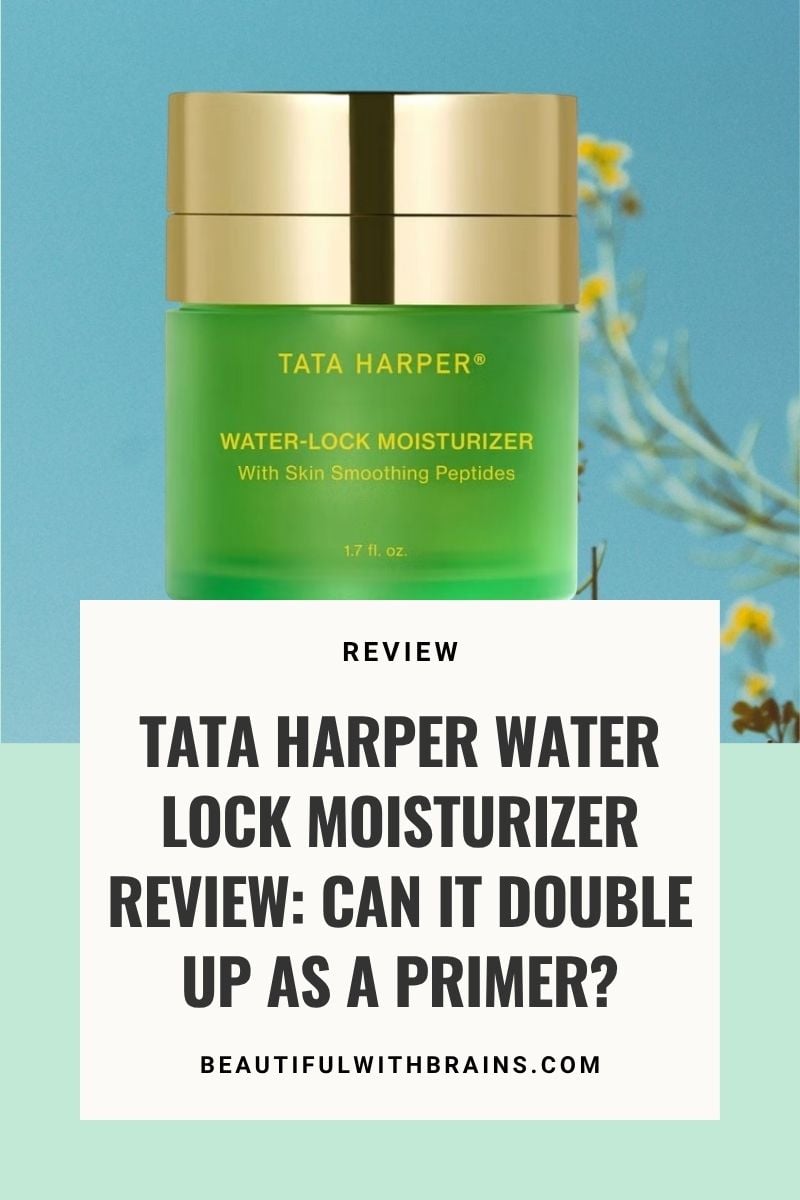
Tata Harper has built its whole identity around clean, luxury skincare, and the Water Lock Moisturizer is one of its flagship products. If you’ve been searching for a proper Tata Harper Water Lock Moisturizer review that actually cuts through the marketing, you’re in the right place. The big claim here is that it works as both a moisturizer and a primer, which is either genuinely clever or just a way to justify a very high price tag for one product doing two jobs. By the end of this review, you’ll know whether this product actually delivers on its promises or whether you’re paying for the green glass jar and a good story. Let’s get started.
- Key Ingredients In Tata Harper Water-Lock Moisturizer: What Makes It Work?
- The Rest Of The Formula & Ingredients
- Texture
- Fragrance
- How To Use It
- Packaging
- Performance & Personal Opinion
- What I Like About The Tata Harper Water Lock Moisturizer
- What I DON’T Like About The Tata Harper Water Lock Moisturizer
- Who Should Use This?
- Does The Tata Harper Water Lock Moisturizer Live Up To Its Claims?
- Price & Availability
- The Verdict: Should You Buy It?
Key Ingredients In Tata Harper Water-Lock Moisturizer: What Makes It Work?
GLYCERIN
Glycerin is a simple, clear, syrupy liquid that’s been used in skincare for over a century. It’s a humectant, meaning its job is to pull water into the outer layer of your skin and hold it there, keeping your skin from drying out throughout the day. Research shows glycerin improves stratum corneum hydration, skin barrier function, and skin mechanical properties. One thing worth knowing: as a humectant, glycerin draws water from the nearest source, which in low-humidity environments can actually be the deeper layers of your own skin. This is rare, but can happen and can make your skin feel a little dry.
SODIUM HYALURONATE
Sodium hyaluronate is the salt form of hyaluronic acid (HA). It’s more stable and slightly smaller in molecular size, which means it sits better in a formula and absorbs more readily. Your body makes HA naturally; it’s part of what keeps skin plump and cushioned. Levels drop with age, which is why it shows up in basically every moisturizer on the market. In this product, it’s acting as a second humectant alongside glycerin, pulling in water and giving skin that immediate plump, dewy look. Research has shown that topical HA produces an immediate increase in the skin’s water-holding capacity, and improvements are cumulative – meaning the hydration effect can build over weeks of use.
Related: The Complete Guide To Layering Acids In Your Skincare Routine
The Rest Of The Formula & Ingredients
NOTE: The colours indicate the effectiveness of an ingredient. It is ILLEGAL to put toxic and harmful ingredients in skincare products.
- Green: It’s effective, proven to work, and helps the product do the best possible job for your skin.
- Yellow: There’s not much proof it works (at least, yet).
- Red: What is this doing here?!
- Hordeum Vulgare Leaf Juice:* This is fresh-squeezed juice from barley leaves, and it’s rich in antioxidants, vitamins, and amino acids; it acts as a skin-conditioning base here, giving the formula a more nutrient-dense liquid foundation than plain water.
- Octyldodecanol: A fatty alcohol that works as an emollient – it’s there to make the texture smooth and silky on skin without feeling heavy or greasy. It also helps other ingredients spread evenly.
- C10-18 Triglycerides: Plant-derived fats (usually from coconut or palm) that do two things: soften skin and thicken the formula..
- Aqua/Water/Eau: The solvent that holds the whole formula together. I
- Cetearyl Alcohol: Don’t let the word “alcohol” throw you – this is a fatty alcohol made from natural oils, not the drying kind. It’s a co-emulsifier and thickener that gives the cream its creamy texture and helps oil and water stay mixed together.
- Shea Butter Ethyl Esters: This is a lighter, more refined version of shea butter – it keeps the moisturizing and barrier-supporting benefits of shea without the heavy, greasy feel of the raw butter.
- Diglycerin: A humectant very similar to glycerin, just slightly larger molecule. It draws moisture to the skin’s surface.
- Sclerotium Gum: A fermentation-derived gum from a fungus that acts as a natural thickener and emulsion stabiliser – it’s what helps keep the oil and water components from separating over time.
- Punica Granatum Extract: Pomegranate extract, which is genuinely high in antioxidants – polyphenols, particularly ellagic acid and punicalagins.
- Citrus Aurantium Dulcis (Orange) Flower Extract: Orange blossom extract – primarily here for fragrance, though it does contain some antioxidant compounds.
- Saccharide Isomerate: A plant-derived sugar complex that mimics the skin’s own natural moisturising factor – meaning it actually binds to the skin itself rather than just sitting on top.
- Beta Vulgaris/Beet Root Extract: Beetroot extract, which contains betaine (a natural humectant) as well as antioxidants and anti-inflammatory compounds. I
- Arnica Montana (Arnica) Extract:* Arnica is classically known for reducing inflammation and bruising.
- Borago Officinalis (Borage) Leaf Extract:* Borage is known for being rich in GLA (gamma-linolenic acid), a fatty acid that supports skin barrier function and has anti-inflammatory effects.
- Calendula Officinalis (Calendula) Flower Extract:* Calendula has anti-inflammatory and wound-healing properties.
- Medicago Sativa (Alfalfa) Extract:* Alfalfa extract contains vitamins, antioxidants, and chlorophyll. The evidence for its topical effects is pretty limited – it’s likely here as a supportive antioxidant ingredient, but it’s not going to be carrying much of the formula at this concentration.
- Spiraea Ulmaria (Meadowsweet) Extract:* Meadowsweet naturally contains salicylates, which have mild anti-inflammatory and soothing properties.
- Sambucus Nigra Fruit Extract: Elderberry extract, high in anthocyanins (purple pigment antioxidants) and vitamins C and A.
- Olea Europaea (Olive) Oil:* Organic olive oil, an occlusive emollient that seals moisture in and softens skin. Rich in squalene and oleic acid, both well-tolerated by most skin types.
- Magnolia Officinalis Bark Extract: Magnolia bark extract contains honokiol and magnolol, compounds with real antioxidant and anti-inflammatory activity.
- Citrus Sinensis (Orange) Peel Oil:* This is where the fragrance is primarily coming from – orange peel essential oil gives the product its citrus scent. It also contains limonene naturally, which is flagged separately at the end of the list because it’s a known allergen for some people.
- Arachidyl Alcohol: A fatty alcohol used as an emollient and emulsion stabiliser. It helps give the cream a thicker, more luxurious texture and contributes to its slip.
- Glyceryl Caprylate: An emollient that also has mild antimicrobial properties, making it part of the preservation system here.
- Sodium Phytate: A chelating agent derived from phytic acid, found naturally in plant seeds. It binds to metal ions in the formula (like iron and calcium) that would otherwise accelerate the degradation of other ingredients.
- Hydrolyzed Corn Starch: Broken-down corn starch that acts as a light film-former and skin softener. It can give a subtle mattifying or velvety finish and help ingredients spread smoothly. This is probably part of what gives the product its primer-like texture.
- Glyceryl Undecylenate: An ester of glycerin and undecylenic acid, primarily used as a mild preservative with some antifungal activity. I
- Cetearyl Glucoside: It helps oil and water stay blended in the formula.
- Behenyl Alcohol: Another fatty alcohol – it thickens the formula and acts as an emollient. It contributes to the rich, creamy texture of the moisturiser and helps slow water loss from skin.
- Sodium Levulinate: A preservative derived from plant sugars, it inhibits the growth of bacteria in the formula.
- Sodium Anisate: The other half of the natural preservative pairing, it’s particularly effective against yeasts and fungi, which sodium levulinate alone doesn’t cover well.
- Arachidyl Glucoside: It helps stabilise the emulsion and contributes to the skin-feel of the product.
- Citric Acid: A mild acid used to adjust the pH of the formula.
- Sodium Citrate: A buffering agent that works alongside citric acid to keep the pH stable over time.
- Lactic Acid: An AHA, but at this low a concentration in a moisturiser it’s functioning primarily as a pH adjuster, not as an exfoliant.
- Phenethyl Alcohol: A naturally occurring aromatic alcohol found in rose essential oil. It smells pleasant.
- Alcohol: This is plain ethyl alcohol, same as in hand sanitiser. At low concentrations it can help ingredients penetrate and has antimicrobial function.
- Limonene: A fragrance compound naturally derived from citrus peel, it gives products that fresh, clean citrus scent. However, it’s a known sensitizer when oxidised.
- Pinene: It contributes to the scent profile (think piney, fresh, herbal notes). Potential allergen for fragrance-sensitive skin.
- Linalool: A terpene fragrance found naturally in lavender, coriander, and many flowers, it gives a soft, floral quality to the scent. Like limonene, it’s a known contact allergen when oxidised.
- Citral: A naturally occurring aldehyde found in lemon, orange, and lemongrass, it’s another fragrance component that adds citrusy brightness to the scent. It’s included in fragrance allergen disclosure lists across the EU and is a known sensitizer in some people, particularly those with existing fragrance allergies.
Texture
The texture on this is genuinely one of its best qualities. It’s a gel-cream – bouncy, almost jelly-like when it comes out – and it melts into skin fast without leaving that greasy film that makes you want to immediately wipe your face with a tissue. It absorbs in under a minute, leaves skin feeling plump and slightly tacky. It doesn’t pill, it doesn’t make foundation slide around, and it actually creates a decent base without needing a separate primer.
Fragrance
There’s a light floral-citrus scent – orange peel oil and lavender, both of which are in the formula. It fades within a minute of application and most people won’t find it offensive. But here’s where I have to be straight with you: those ingredients bring limonene, linalool, and citronellol along for the ride, which are some of the most common contact allergens in skincare. At $70+, a moisturiser shouldn’t be asking you to absorb unnecessary sensitising risk.
How To Use It
Apply after cleansing and toning, before SPF. Morning and night. One to two pumps over face and neck. That’s it. It’s designed to be the final step before sun protection in the morning, and the last step at night.
Packaging
The frosted glass jar is beautiful. I’m not going to pretend otherwise. It looks expensive on a shelf and it feels expensive in your hand. But a jar is genuinely a worse delivery format than an airless pump for anything with active ingredients or antioxidants, because every time you open it, you’re exposing the formula to air and bacteria. The refillable pod system is actually clever though – it locks into the outer jar, reduces packaging waste meaningfully, and the refill is cheaper than the starter kit.
Performance & Personal Opinion
Here’s the honest version: this is a genuinely good moisturiser for a specific type of person, and a frustrating one for everyone else. If you have normal to combination skin, live somewhere with reasonable humidity, and want a lightweight daily moisturiser that doubles as a primer, this works. But if you have dry skin, especially in winter? It will feel amazing for about four hours and then your face will feel tight and forgotten. The fragrance inclusion still bothers me. Not because it’s dangerous at these concentrations for most people, but because it’s sloppy formulation. You’ve got good actives, a thoughtful hydration system, a sustainability story worth telling – and then you throw in essential oils that serve zero skincare function and create risk for a meaningful chunk of your potential customers.
What I Like About The Tata Harper Water Lock Moisturizer
- The gel-cream texture is genuinely satisfying – bouncy, fast-absorbing, never greasy
- Works as a legitimate primer substitute; doesn’t pill under makeup or SPF
- Immediate plumping effect is real and noticeable within seconds of application
- The scent is light and fades fast
- Refillable pod system is one of the better sustainability executions in prestige skincare
- Sits well in a layered routine; plays nicely with serums underneath and SPF on top
What I DON’T Like About The Tata Harper Water Lock Moisturizer
- Fragrance can irritate sensitive skin
- The glass jar is gorgeous and functionally inferior – air exposure every time you open it is a real formulation stability issue that an airless pump would have solved
- Not particularly anti-aging
Who Should Use This?
- Combination to normal skin, moderate climates, year-round.
- Oily skin that still needs hydration but hates anything that sits heavy.
- People who want to cut a step by skipping a separate primer.
- Anyone already bought into the clean beauty space who wants formulation integrity to match the ethos – this mostly delivers that.
- Not for: dry skin in winter, anyone with rosacea, fragrance sensitivity, and contact dermatitis history.
Does The Tata Harper Water Lock Moisturizer Live Up To Its Claims?
| CLAIM | TRUE? |
|---|---|
| This lightweight gel-cream moisturizer with hyaluronic acid and peptides delivers long-lasting hydration while creating a smooth canvas for flawless makeup application. | True. |
| Our glow-boosting hydrator and skin-perfecting primer in one. | This one actually holds up. The gel-cream texture creates a smooth, slightly tacky base that grips SPF and foundation without pilling or causing slippage. It’s not a replacement for a full silicone-based primer if you need serious pore blurring, but as a skin-prep step it genuinely works and cuts out a product. |
| “Suited for all skin types” | No. Normal and combination, yes. Dry skin needs more occlusion. Sensitive and reactive skin needs no essential oils. |
Price & Availability
$72 at Cult Beauty, Nordstrom, Sephora, and Tata Harper
The Verdict: Should You Buy It?
- If you have combination or normal skin and you’re in the market for a well-formulated lightweight moisturiser that genuinely doubles as a primer – yes, this is worth trying.
- If you have dry skin, sit this one out. It won’t carry you through a full day without backup.
- If you have sensitive or reactive skin, the essential oil situation is a real dealbreaker regardless of how much you like everything else about it.
- And if you’re budget-conscious – genuinely, there are gel-creams in the $25-40 range doing comparable humectant work.
Ingredients
Hordeum Vulgare Leaf Juice*, Octyldodecanol, C10-18 Triglycerides, Glycerin, Aqua/Water/Eau, Cetearyl Alcohol, Shea Butter Ethyl Esters, Diglycerin, Sclerotium Gum, Punica Granatum Extract, Citrus Aurantium Dulcis (Orange) Flower Extract, Sodium Hyaluronate, Saccharide Isomerate, Beta Vulgaris/Beet Root Extract/Extrait de Racine de Betterave, Arnica Montana (Arnica) Extract*, Borago Officinalis (Borage) Leaf Extract*, Calendula Officinalis (Calendula) Flower Extract*, Medicago Sativa (Alfalfa) Extract*, Spiraea Ulmaria (Meadowsweet) Extract*, Sambucus Nigra Fruit Extract, Olea Europaea (Olive) Oil*, Magnolia Officinalis Bark Extract, **Citrus Sinensis (Orange) Peel Oil*, Arachidyl Alcohol, Glyceryl Caprylate, Sodium Phytate, Hydrolyzed Corn Starch, Glyceryl Undecylenate, Cetearyl Glucoside, Behenyl Alcohol, Sodium Levulinate, Sodium Anisate, Arachidyl Glucoside, Citric Acid, Sodium Citrate, Lactic Acid, Phenethyl Alcohol, Alcohol, Limonene, Pinene, Linalool, Citral