
Last Updated on September 9, 2026 by Giorgia Guazzarotti

- “My skin is ALWAYS dry and flaky, no matter what I do.”
- “I’m afraid of trying new skincare products. My skin’s so sensitive, it can’t tolerate ANYTHING!”
- “Every time I wash my face, my skin feels so tight and dry.”
Sounds familiar? That’s your acid mantle screaming for help. In plain English, your acid mantle is basically this thin, slightly acidic layer on your skin that acts like a bouncer at a club: it keeps all the bad stuff (think bacteria and environmental aggressors) out, lets the good stuff (think moisture and antioxidants) stay in. But when you mess it up (hello, those “deep clean” face washes we all thought were doing us favors), your skin just… falls apart. IT gets dry, angry, hates literally everything you try to put on it.
Good news: you can 100% fix a damaged skin acid mantle. And honestly? It’s way easier than you think. No crazy routines, no spending your rent money on fancy creams. So we’re gonna talk about what this whole acid mantle thing actually is, how we all accidentally destroyed ours, and how to bring it back to health. What products actually work, what you need to throw in the trash like yesterday, and how long before your skin chills out again. Let’s fix this thing.
- What Is The Acid Mantle Made Up Of?
- Is The Acid Mantle The Same As Your Skin Barrier?
- Skin Acid Mantle: What Does It Do?
- What Damages Your Acid Mantle?
- How Do You Know If Your Acid Mantle Is Damaged?
- How To Restore Your Acid Mantle
- FAQs About The Acid Mantle
- How Long Does It Take To Repair A Damaged Acid Mantle?
- Can You Repair Your Acid Mantle Naturally?
- What pH Should My Skincare Products Be?
- Can Drinking Water Help Restore The Acid Mantle?
- Can A Damaged Acid Mantle Cause Acne?
- Can Retinol Damage Your Acid Mantle?
- Does CeraVe Repair The Acid Mantle?
- Do You Need A pH-Balancing Toner?
- The Bottom Line
What Is The Acid Mantle Made Up Of?
Acid mantle is a protective, hydro-liquid film that sits on the top of your skin. Think of it like a wall between you and the world. It’s called acid because it’s slightly acidic. It needs to be. That’s what makes your skin inhospitable to fungi and bacteria, so they don’t grow and multiply all over your skin. Your acid mantle is made up of a mixture of oils and water. Here’s the full list:
- Amino acids
- Essential fatty acids
- Lactic acid
- Pyrrolidine carboxylic acid
- Urocanic acid
- Water
Put all these ingredients together and they create an acidic environment of around pH 4.5-5.5. That’s the natural, correct pH of your skin. This acidic vibe is what keeps bacteria from throwing a party on your face and stops all your moisture from evaporating into thin air. The second your skin’s pH gets thrown off and becomes more alkaline? Everything goes to hell.
Related: Why You Should Add Amino Acids To Your Skincare Routine
Is The Acid Mantle The Same As Your Skin Barrier?
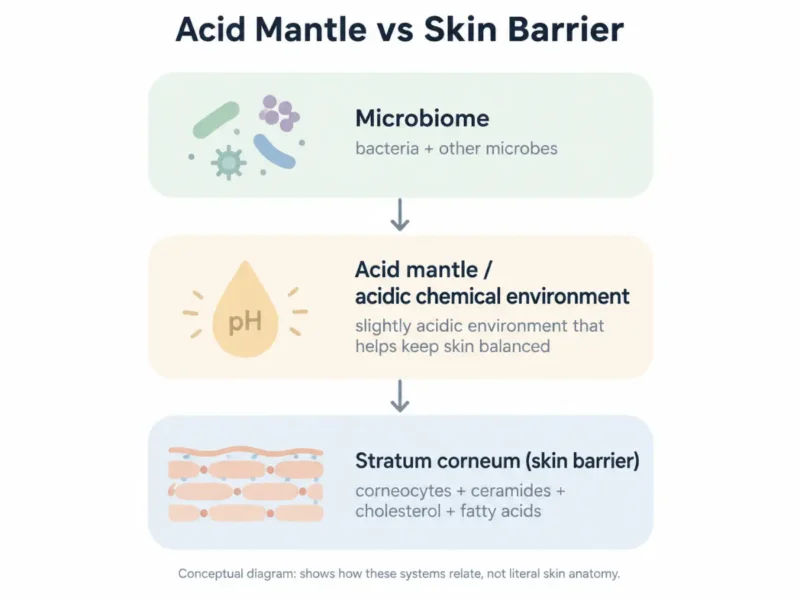
Nope. They’re closely connected, but they’re not the same thing. Your skin barrier is the physical barrier made up of skin cells and lipids like ceramides, cholesterol and fatty acids. Your acid mantle is the acidic environment that helps that barrier work properly.
Think of your skin barrier as the wall keeping moisture in and irritants out. The acid mantle helps keep that wall in good working order by maintaining the right pH for barrier enzymes and keeping certain bacteria and other pathogens in check.
That’s why you’ll often hear people talk about a “damaged acid mantle” and a “damaged skin barrier” as if they’re the same thing. Mess with one and you can affect the other.
Struggling to put together a skincare routine that banishes dryness and makes your skin supple and dewy? Download your FREE “Best Skincare Routine For Dry Skin” to get started (it features product recommendations + right application order):
Skin Acid Mantle: What Does It Do?
Your acid mantle is your first line of the defence against everything that wants to hurt your skin. It protects it from freezing cold winds, the blistering hot sun, bacteria and germs and all its other enemies. Plus, it keeps your skin soft and supple. When your acid mantle’s intact, moisture stay in and germs & co stay out. Your skin is healthy, soft and resistant (it tolerates everything).
Problem is, the acid mantle is ALWAYS under attack. A dent here today, a knock there tomorrow and pretty soon your acid mantle breaks down all over the place. Now moisture escapes through the cracks. Germs & bacteria get a free way in. Your skin gets dry. Red. Flaky. Everything stings and irritates it like crazy.
What Damages Your Acid Mantle?
Your acid mantle is pretty resilient. You don’t destroy it because you washed your face once or used an exfoliant on Tuesday. The problem is repeatedly doing things that strip your skin, irritate it or keep pushing its pH up or down too much.
The Big Skincare Offenders
- Alkaline soaps: Traditional soaps tend to have a much higher pH than your skin, so they can temporarily push skin pH upwards and make it harder for your barrier to do its job properly.
- Overcleansing: Washing too often (especially with a harsh cleanser!) strips away some of the oils and lipids your skin needs to stay healthy.
- Overexfoliation: Acids, scrubs and exfoliating toners are great in moderation. Use too many, too often, and you can irritate your skin and weaken its barrier.
- Irritating skincare: Strong actives, fragranced products and anything your skin simply doesn’t tolerate can leave it inflamed and more vulnerable.
- Too many actives at once: Retinol, acids, vitamin C, benzoyl peroxide… individually, your skin may handle them just fine. Throw everything at your face at once and your barrier may eventually tell you where to go.
Basically, if your routine leaves your skin constantly tight, stingy, flaky or angry, more skincare probably isn’t the answer.
Things You Can’t Entirely Control
Skincare isn’t the only thing that affects your acid mantle. Age, climate and your environment can all influence skin pH and barrier function. Cold, dry weather can increase water loss and leave skin more vulnerable, while things like heat, pollution and UV exposure can add extra stress and sun damage.
Certain skin conditions matter, too. Changes in skin pH are commonly seen in inflammatory conditions such as atopic dermatitis. That doesn’t mean a damaged acid mantle causes eczema. It’s more complicated than that. Skin pH, barrier function, inflammation and the microbiome all influence each other.
So if your skin is chronically red, itchy, cracked or inflamed even after you’ve stripped your routine right back, don’t automatically blame your cleanser. There may be more going on than a temporarily unhappy acid mantle.
Related: 5 Skincare Treatments That Can Ruin Your Skin (If You Abuse Them)
How Do You Know If Your Acid Mantle Is Damaged?
You can’t look at your face and know for sure that your skin’s pH is out of whack. But when your acid mantle and skin barrier aren’t working as well as they should, your skin usually lets you know pretty quickly. Common signs include:
- Your skin feels tight after cleansing
- Products that normally don’t bother you suddenly sting
- Persistent dryness or flaking
- Redness and irritation
- Rough or uneven texture
- Your skin suddenly feels much more sensitive than usual
The annoying part? These symptoms aren’t exclusive to a damaged acid mantle. Eczema, contact dermatitis, over-exfoliation and plain old irritation can look very similar.
But if your skin was doing fine and then suddenly became dry, tight, stingy and angry after you introduced a harsh cleanser, went wild with exfoliating acids or piled on too many actives, there’s a good chance you’ve messed with your skin barrier and the acidic environment that helps support it.

How To Restore Your Acid Mantle
First of all, how can you tell your acid mantle is damaged? Easy. If your skin feels tight after washing, is always dry and everything you put on it irritates it like crazy, the damage’s done. Your acid mantle needs fixing. Here’s how:
Step 1: Stop Stripping Your Skin When You Cleanse
If your acid mantle is already struggling, the last thing you want to do is strip away even more of the oils and other stuff your skin needs to protect itself every time you wash your face.
Traditional soap is one of the worst offenders. Your skin is naturally acidic, while old-school soaps tend to be highly alkaline, often around pH 8.5-11. That temporary jump in pH can interfere with the enzymes and lipids your skin barrier needs to work properly. Plus, harsh cleansers can strip away ceramides, cholesterol and fatty acids from your skin. Exactly what you don’t need when you’re trying to repair it.
FYI, foaming cleanser doesn’t automatically mean harsh cleanser. Foam is just foam. Modern cleansers can use milder synthetic cleansing agents (a.k.a. syndets) and still lather up without trashing your skin barrier. On the flip side, just because a cleanser boasts a “skin-friendly pH” doesn’t automatically make it gentle, either. The type and amount of surfactants it uses (and how the whole formula is put together matter, too.
So how do you know if your cleanser is too harsh? Pay attention to your skin. If your face feels squeaky clean, tight, dry or uncomfortable after washing, that’s not proof your cleanser is “working.” It’s a pretty good sign you need something gentler.
For now, ditch traditional soap and anything that leaves your face feeling stripped. Choose a mild cleanser that gets rid of sunscreen, makeup and excess sebum without making your skin feel like it’s two sizes too small afterwards.
Best Picks:
- CeraVe Hydrating Facial Cleanser ($15.99): A cream cleanser loaded with ceramide to remove impurities while strengthening your skin’s protective barrier. Click here for the full review. Available at Boots, Cult Beauty, Look Fantastic, Sephora, and Ulta.
- Corsx Low PH Good Morning Gel Cleanser ($14.00): A gentle pH-balanced (5.5) foaming cleanser that gets rid of excess oil and impurities without drying out skin. Click here for my full review. Available at Sokoglam and YesStyle.
- Paula’s Choice Skin Recovery Softening Cream Cleanser ($24.00): This moisturising cleanser uses a mix of surfactants and natural oils to remove impurities and makeup from skin, leaving it soft and clean. Available at https://on.ltk.com/+rOYzDLOV7qh1kmSQP1tfyA.

Related: Why You Should Stop Washing Your Face With Soap
Step 2: Give Exfoliation A Break
I’m all for exfoliation. It brightens dull skin, smooths rough texture and helps fade dark spots. But when your acid mantle and skin barrier are already struggling, more exfoliation is the LAST thing they need.
Exfoliants work by loosening or removing some of the dead cells sitting on the skin’s surface. Normally, that’s fine. But those dead cells aren’t useless rubbish waiting to be scrubbed away. They’re part of the stratum corneum, the outermost layer of your skin barrier that helps keep water in and irritants out.
Exfoliate too much and you can disrupt that barrier faster than your skin can repair it. Cue dryness, flaking, redness and that lovely moment when even your boring moisturiser suddenly starts to sting. So put the glycolic acid down. Step away from the peel. And please stop using three different exfoliants because TikTok told you they’re all “essential.”
Give your skin a proper break until it feels comfortable again. No stinging. No flaking. No constant tightness. Then, if you want to start exfoliating again, bring back one exfoliant at a time and don’t immediately go back to using it every night.
Related: Is Exfoliation For Everyone?
Step 3: Pause Irritating Actives
Exfoliants aren’t the only products that can make already-irritated skin even angrier. Retinoids, benzoyl peroxide, strong vitamin C formulas and other powerful actives may be perfectly fine when your skin is healthy. Right now, they’re extra work your barrier doesn’t need.
That doesn’t mean these ingredients are “bad” or that they damage everyone’s acid mantle. It just means irritated skin is more likely to react to products it normally tolerates. For now, your wrinkles, dark spots and breakouts can wait. Strip your routine back to the boring essentials: gentle cleanser, moisturiser and sunscreen. Once your skin stops feeling dry, tight, flaky and stingy, you can slowly start bringing your actives back.
If you cheat and sneak in those actives anyway before your skin is ready, you’ll just end up having to put them aside once your skin screams in pain… It’ll take you longer to heal your skin. The longer it takes, the more you have to wait before going back to anti-aging products. Not worth it, is it?

Step 4: Use A Barrier-Repair Moisturiser
Now’s not the time for a moisturiser that promises to exfoliate, brighten, and reverse 10 years of sun damage before breakfast. You need something boring. Very boring. Look for ingredients that hydrate your skin and help rebuild the lipid barrier, like ceramides, cholesterol and fatty acids (the same types of lipids naturally found in your skin barrier).
Humectants like glycerin and hyaluronic acid help pull water into the skin for extra hydration, while ingredients like petrolatum and squalane help stop it escaping again. You don’t need every single one of these ingredients in the same cream. You just need a moisturiser that’s gentle, fragrance-free if your skin is particularly reactive, and rich enough to stop your face feeling tight and dry five minutes after you apply it. Right now, repairing your barrier matters more than fighting wrinkles.
Best picks:
- Cerave PM Facial Moisturising Lotion ($19.99): It uses humectants that hyaluronic acid and glycerin to attract water into your skin and ceramides to moisturise skin without adding more oil to it. Read my full review here. Available at Beauty Bay, Boots, Cult Beauty, Dermstore, and Ulta.
- Paula’s Choice Omega+ Complex Moisturizer ($42.00): One of the richest moisturisers I know, this baby is loaded with fatty acids to deeply moisturise even the driest of skin types. Available at Cult Beauty, Dermstore and Paula’s Choice.
- The Ordinary Natural Moisturising Factors + HA ($6.70): A lightweight cream with hyaluronic acid and amino acids to restore your acid mantle. Read my full review here. Available at Asos, Beauty Bay, Cult Beauty, SpaceNK, The Ordinary, and Ulta
Related: The Complete Guide To Repairing Your Skin’s Barrier
Step 5: Protect Your Skin With Sunscreen
Yes, even while you’re giving the rest of your routine a break. UV radiation can damage the skin barrier and increase inflammation, which is the exact opposite of what you want when your skin is already struggling. So sunscreen stays.
Use a broad-spectrum SPF 30 or higher every morning and pick a formula your skin can actually tolerate. If your usual sunscreen suddenly stings, don’t force yourself to suffer through it because it’s your “holy grail.” Irritated skin can react to products that normally don’t bother it. For now, the best sunscreen is the one that protects your skin without making it even angrier.
Best Picks:
- Drunk Elephant Umbra Tinte Physical Daily Defense Broad Spectrum Sunscreen SPF 30 ($36.00): A tinted mineral sunscreen that’s gentle enough for sensitive skin. Available at Boots, Cult Beauty, Look Fantastic, and SpaceNK
- EltaMD UV Pure Broad-Spectrum SPF 47 ($43.00): One of the best sunscreens for oily skin, it provides broad spectrum protection without the stickiness. Available at Dermstore
- Paula’s Choice Super-Light Daily Wrinkle Defense SPF 30 ($39.00): My fave mineral sunscreen, it’s super lightweight and doesn’t leave a greasy residue behind. It’s suitable even for oily skin. Read my full review here. Available at Cult Beauty, Dermstore and Paula’s Choice
Related: Why Mineral Sunscreens Are Better For Skin Sensitivity
Step 6: Slowly Reintroduce Your Actives
Once your skin stops feeling tight, flaky, sore and stingy, you can start bringing your favourite actives back. The key word here is slowly. Don’t celebrate your newly healthy skin by throwing retinol, glycolic acid, vitamin C and three serums at it on the same night. Otherwise, congratulations: you’re right back where you started.
Bring back one active at a time. Start using it less often than you did before and give your skin time to tell you whether it’s happy with it. If everything feels fine, you can gradually increase how often you use it. Then introduce the next product. And if the dryness, burning or flaking comes straight back? That’s your skin telling you you’re moving too fast. Listen to it. Understanding your skin is the first step to healing it.
FAQs About The Acid Mantle
How Long Does It Take To Repair A Damaged Acid Mantle?
Honestly? It can take 2-4 weeks if you stop doing whatever’s been wrecking it. Some people see their skin get back to normal in a week. In most cases, it takes longer. It just depends how damaged it is and if you’re actually gonna stick to the routine above. A damaged acid mantle is not gonna be fixed overnight, your skin needs time to heal.
Can You Repair Your Acid Mantle Naturally?
Yeah your skin does it by itself. You just gotta stop getting in the way. Stop using harsh stuff, stop washing your face a million times, use boring gentle products. That’s it. No magic cream needed, just let your skin do what it’s supposed to do to restore harmony.
What pH Should My Skincare Products Be?
For most skincare products, 4.5-5.5, same as your skin. But you don’t need to walk around testing everything. Just don’t use bar soap cause that’s like pH 9 or 10 which is insane. Most normal cleansers are fine these days anyway. Exfoliants and Vitamin C serums can be a little lower. And that’s why you need to moisturise well afterwards to restore skin balance.
Can Drinking Water Help Restore The Acid Mantle?
Nah not really. Water’s good for you but it’s not fixing this. You need to fix what you’re putting ON your face not just drinking more water. Drink water sure but also get a moisturizer.
Can A Damaged Acid Mantle Cause Acne?
Maybe. But I wouldn’t blame every breakout on your acid mantle. Acne is complicated. Oil, clogged pores, inflammation and bacteria C. acnes all play a role. Your acid mantle is just one piece of the puzzle.
We do know that acne-prone skin tends to have a higher pH than clear skin, and that can affect your skin barrier, inflammation and microbiome. But that doesn’t prove a damaged acid mantle causes acne. So yes, keeping your acid mantle and skin barrier healthy may help. No, repairing your acid mantle isn’t some secret acne cure.
Can Retinol Damage Your Acid Mantle?
Not exactly. Retinol can mess with your skin barrier if you use too much, too often or your skin just isn’t ready for it. That’s when you get the classic retinol side effects: dryness, peeling, redness and that delightful burning sensation when even your moisturiser suddenly hurts.
That doesn’t mean retinol is bad. I love retinol. But if your skin is already flaky, sore and irritated, piling more retinol on top isn’t going to win you any prizes. Give your skin a break. Let it recover. Then bring retinol back slowly.
Does CeraVe Repair The Acid Mantle?
CeraVe can help repair your skin barrier. That’s not quite the same thing as directly repairing your acid mantle. A lot of CeraVe moisturisers contain ceramides, which are naturally found in your skin barrier and help keep it strong and stop moisture escaping. That’s useful when your skin is dry and irritated.
But CeraVe isn’t sprinkling a brand-new acid mantle over your face. Your skin restores its own acidic environment. A good moisturiser just gives it a much better chance to get on with the job and do it more quickly. So use CeraVe if your skin likes it. Just don’t buy it because someone’s convinced you it’s the only cream capable of “fixing your pH.”
Do You Need A pH-Balancing Toner?
No. This is one of those skincare rules that refuses to die. Yes, cleansing can temporarily raise your skin’s pH, especially if you’re using old-school alkaline soap. But your skin can bring its pH back down by itself. It does not need a toner standing there with a clipboard supervising the process.
The whole “you MUST use toner to rebalance your skin’s pH after cleansing” thing made a lot more sense when people were washing their faces with much harsher soaps. These days? You don’t need it.
The Bottom Line
If your skin’s dry, irritated and sensitive all the time, your acid mantle is damaged. That’s your cue to go back to basics with your skincare. Throw out anything remotely irritant and moisturise, moisturise, moisturise.
In a case where disease conditions like eczema destory your acid mantle what skin product can be used to repair the acid mantle.
In a case of a baby what skin product can be use to repair the acid mantle.
Philomina, try an oil like jojoba or squalane. They’re almost identical to human sebum so unlikely to cause any negative reaction.
Hi Gio, thanks for this post. It’s my experience that moisturizers delay the skin’s natural restoration of the acid mantle. Ideally, a healthy acid mantle itself draws moisture in and keeps it in, right? So how can we stop the addiction to moisturizer and repair the acid mantle at the same time? Thanks!
Lise, why do you think that moisturisers delay the skin’s natural restoration of the acid mantle? On the contrary, a properly formulated moisturiser helps speed it up. It’s only when your moisturiser contains harsh actives like retinol or irritating ingredients like fragrance, that you’re compromising the acid mantle more.
Hi Gio, in the case that the acid mantle is disrupted causing acne and irritation, will the moisturizing exacerbate the acne? I’m afraid to use moisturizers because I’m afraid my oil production will go haywire causing more breakout. Excessive oil production was the original reason why I have over exfoliated wrecking my acid mantle. Any help will truly be appreciated. Thank you!
T, as long as you use an oil-free moisturiser like CeraVe PM lotion, you shouldn’t experience breakouts.
Hi Gio, when the acid mantle is disrupted does it help touse oils or serum or moisturiser with omega fatty acid? Thank you
Oh and I have also an other question. So it is okay to wash your face with just water or it would be better to use the gentle cleanser?
Hi Gio, do the use of oils (like Argan or jojoba) help to restore the acid mantle? And in case of damaged acid mantle is better to was the face just with water or with a gentle cleanser? Thank you!
Lina, yes you can use oils to restore the acid mantle. I recommend gentle facial cleansers for this. You can find my fave in the post. It’s all clearly explained above. 🙂