
Last Updated on September 7, 2026 by Giorgia Guazzarotti
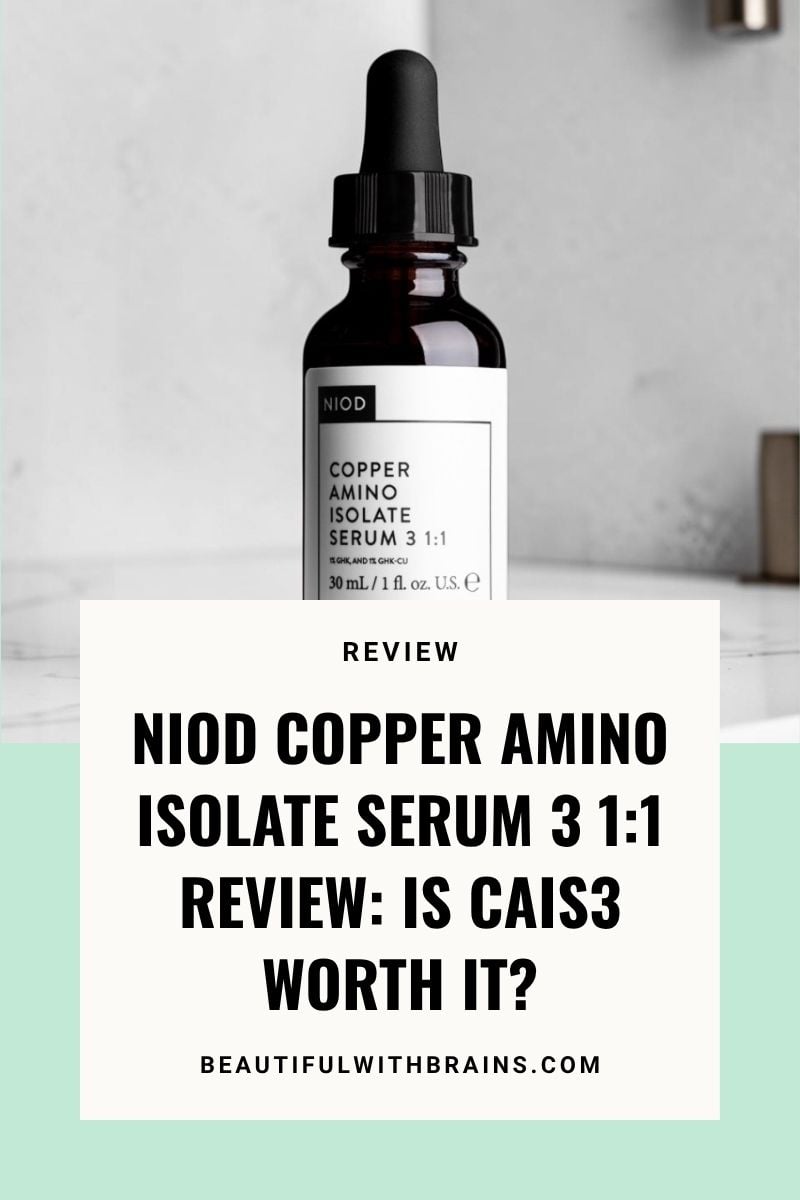
You don’t know what you’ve got till it’s gone. That’s how I felt about NIOD Copper Amino Isolate Serum 3 1:1. The first time I tried it, it wasn’t love at first sight. It just didn’t seem to do anything! But when I ran out, oh my, did I see a difference! I couldn’t put my finger on it but somehow, my skin just didn’t look as good anymore. It took longer to heal. It was just behaving differently (and not in a good way!).
And that pretty much sums up my experience with NIOD CAIS3: it works, but the results are subtle. This isn’t a serum that dramatically changes your skin overnight. It definitely doesn’t work after a single use. It’s more of a long-term maintenance product that helps keep skin looking and behaving its best. Let’s get into the full review now.
The Verdict
My rating: 4/5.
Best for: Anyone who already has the basics of a good anti-aging routine in place and wants to add copper peptides for extra skin-repair and anti-aging support.
Skip it if: You want dramatic results, you’re on a tight budget, or you haven’t nailed the basics like sunscreen and retinoids yet.
What I like: The super-lightweight texture, how quickly it sinks in, and the subtle improvement I notice in how smooth and healthy my skin looks and behaves.
What I don’t: The results are subtle, it takes time to see a difference, and it’s expensive for something that isn’t an essential part of an anti-aging routine.
Bottom line: NIOD Copper Amino Isolate Serum 3 1:1 is a good copper peptide serum for keeping skin in top shape, but don’t expect dramatic before-and-after results. I notice its benefits more when I stop using it than while I’m using it, and for me, it’s a nice extra rather than a must-have.
- The Verdict
- NIOD Copper Amino Isolate Serum 3 1:1 Ingredients: What Does The Science Say?
- What’s In NIOD Copper Amino Isolate Serum 3 1:1?
- My Experience With NIOD Copper Amino Isolate Serum 3 1:1
- Texture
- Fragrance
- How To Use It
- Packaging
- Performance & Personal Opinion
- Who Should Buy NIOD CAIS3?
- Who Should Skip It?
- Does Niod Copper Amino Isolate Serum 2:1 Live Up To Its Claims?
- Price & Availability
- What Age Should You Start Using Copper Peptides?
- NIOD CAIS3 vs The Ordinary Multi-Peptide + Copper Peptides 1%: Which Is Better?
- What Can You Use With NIOD CAIS3?
- Can Copper Peptides Replace Retinol?
- The Verdict: Should You Buy It?
NIOD Copper Amino Isolate Serum 3 1:1 Ingredients: What Does The Science Say?
What’s In NIOD Copper Amino Isolate Serum 3 1:1?
GHK-Cu + GHK: The Stars Of The Formula
The main reason to buy this serum is GHK-Cu, also known as Copper Tripeptide-1. GHK-Cu is a copper peptide naturally found in the body. Research suggests it plays a role in skin repair, collagen production and inflammation. Other research has linked it to wound healing, antioxidant activity and tissue repair. Sounds amazing, right?
Not so fast. Most of the research on copper peptides has been done in labs rather than on people using copper peptide serums on their faces. A recent review of the evidence found that there’s still surprisingly little good clinical research showing how well GHK-Cu penetrates skin and reduces wrinkles when you apply it topically.
NIOD also contains 1% GHK, basically the same peptide without the copper attached. Lab research suggests GHK may also support healthy skin cells and skin repair, but again, we don’t have lots of good human studies showing what it can do for wrinkles.
So, copper peptides are promising, but they’re nowhere near as proven as retinoids for anti-aging. Hence why I recommend them only when you have all the tried and tested anti-aging actives, like retinol and sunscreen, in your skincare routine.
If you’re wondering whether you should spend your money on copper peptides or stick with retinol, I’ve compared copper peptides vs retinoids for anti-ageing here.
What About All The Other Peptides?
NIOD also includes several other anti-aging peptides. The problem? The evidence behind them is much weaker than the evidence for GHK-Cu.
- Tripeptide-29: Made from amino acids found in collagen. A 2026 study found improvements in wrinkles, firmness and texture after four weeks, but it was tested as part of a full moisturiser, so we don’t know how much Tripeptide-29 contributed.
- Myristoyl Nonapeptide-3: Designed to mimic some of retinoic acid’s effects. Manufacturer testing suggests it may stimulate collagen, but good independent human studies are still lacking.
- Tripeptide-2: Often claimed to help protect collagen and elastin, but I couldn’t find convincing published human research on topical Tripeptide-2 itself.
- Acetyl Tetrapeptide-2: A lab study found effects on human skin cells, like improvements in fine lines and texture. But again, it wasn’t tested alone.
Glycerin + Hyaluronic Acid
CAIS3 also contains glycerin and Sodium Hyaluronate Crosspolymer, a form of hyaluronic acid. Glycerin attracts water into the skin and helps keep the skin barrier hydrated. Sodium Hyaluronate Crosspolymer also holds onto water, helping skin feel softer and look temporarily smoother and plumper. If your skin looks smoother after using NIOD CAIS3, don’t automatically assume the copper peptides rebuilt all your collagen. Some of that improvement may simply come from better hydration.
My Experience With NIOD Copper Amino Isolate Serum 3 1:1
- Skin condition: Generally in good condition, with a few fine lines but no deep wrinkles or major skin concerns.
- Copper peptide experience: I’ve used previous versions of NIOD CAIS before, so I already knew what to expect from copper peptides.
- How long I used it: 3 months.
- How often: Every other night, right after cleansing.
- What I noticed: A small improvement in skin texture. The results were subtle, but my skin seemed to look and behave better with consistent use.
- Verdict: A great maintenance serum, but not a must-have.
Texture
If you’re worried that a higher concentration of copper peptides translates into a thicker, sticky texture, don’t. Its consistency is every bit as watery and lightweight as its predecessor. It absorbs just as fast. Phew!!
Fragrance
The serum itself is fragrance-free. But the ingredients don’t smell the best. Still, it fades away fast, so it doesn’t really bother me.
How To Use It
Unlike the old CAIS 2, NIOD CAIS3 comes pre-mixed, so there’s no activator to pour in or bottles to shake together. Apply a few drops morning and night right after cleansing, before thicker serums, moisturisers and oils. Gently massage it in and give it a few seconds to absorb before moving on with the rest of your routine. And yes, it’s still that gorgeous bright blue colour.
Packaging
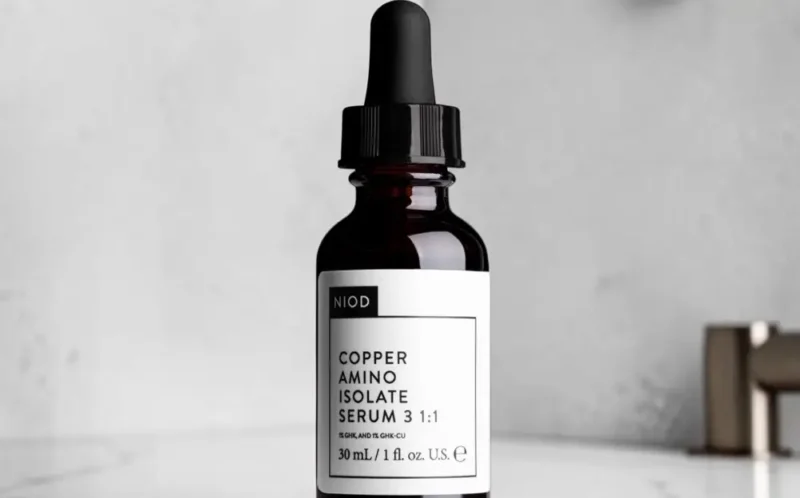
NIOD CAIS3 comes in a dark glass bottle with a dropper applicator. It looks sleek, feels suitably premium for the price, and the dark bottle helps protect the formula from light. The dropper also makes it easy to control how much product you use, although the serum is so watery that you need to be a little careful not to drip it everywhere. Overall, the packaging is practical, simple and works well for the formula.
Performance & Personal Opinion
Copper peptides aren’t the kind of ingredient that gives me an instant wow effect, and NIOD CAIS3 was no exception.
During the first few weeks: Honestly, I didn’t notice much. My skin already looked pretty good, so there wasn’t an obvious change in fine lines, skin texture or anything else I could point to.
After about a month: I started to notice a small improvement in my skin’s texture. It looked smoother and just generally healthier, but the difference was subtle.
What surprised me most: I actually noticed the difference more AFTER I stopped using it. My skin didn’t look quite as good and seemed to take longer to recover when something irritated it. That’s why I think of copper peptides as more of a maintenance ingredient than something that dramatically transforms your skin.
Who Should Buy NIOD CAIS3?
Try it if:
- You already have sunscreen, retinoids etc. covered and want to take your anti-ageing routine further.
- You specifically want a high-concentration copper peptide serum.
- You prefer very lightweight serums.
- You’re patient enough to wait for subtle results.
Who Should Skip It?
- You’re looking for dramatic wrinkle reduction.
- You’re on a tight skincare budget.
- You haven’t yet invested in proven basics like sunscreen.
- You just want to experiment with copper peptides (a cheaper serum makes more sense first).
Does Niod Copper Amino Isolate Serum 2:1 Live Up To Its Claims?
| CLAIM | TRUE? |
|---|---|
| A foundational copper peptide (1% GHK-Cu) serum to help restore the look of healthy skin. | True. Keep in mind, it promises it will make your skin LOOK better, not function better or repair anything. |
| Improves the look of skin aging, minimizing the appearance of fine lines and wrinkles. | True. Again, it only promises to improve the look of wrinkles, not affect their size. |
| Promotes natural collagen, helping skin feel firmer over time. | It can help, but other ingredients (like retinoids) have more evidence supporting this. |
Price & Availability
$93.00 at Cult Beauty, Niod, Sephora, and SpaceNK
What Age Should You Start Using Copper Peptides?
There’s no magic age when you suddenly need copper peptides. Your natural levels of GHK do go down as you get older. One review found they’re much higher in your 20s than they are later in life. But that doesn’t mean everyone needs to start using copper peptides the second they turn 30. If you’re starting to notice signs of ageing and already have the basics covered, copper peptides can be a nice extra.
NIOD CAIS3 vs The Ordinary Multi-Peptide + Copper Peptides 1%: Which Is Better?
Both contain 1% copper peptides, so on paper, The Ordinary looks like the better deal. But that wasn’t my experience.
- NIOD CAIS3: Contains 1% GHK-Cu + 1% free GHK, plus several other peptides. It’s much more focused on copper peptides.
- The Ordinary Multi-Peptide + Copper Peptides 1%: Contains 1% copper peptides plus several other peptides, amino acids and hyaluronic acid.
- My experience: The Ordinary did absolutely nothing for my skin. With NIOD, the results are subtle, but I do notice my skin looks and behaves better when I use it consistently.
What Can You Use With NIOD CAIS3?
There’s a LOT of conflicting advice online about what you can and can’t mix with copper peptides. Most of it is repeated from brand instructions rather than actual research. Here’s what the science says:
- Hyaluronic acid: YES. A 2023 study found that GHK-Cu and hyaluronic acid worked well together and increased collagen IV in skin cells and ex-vivo human skin.
- Glycerin, ceramides, niacinamide and moisturiser: YES. There’s no evidence that any of these ingredients deactivate GHK-Cu or stop it from working.
- Sunscreen: YES. There’s no known problem with using copper peptides underneath sunscreen. In fact, if you’re using CAIS3 for anti-aging, sunscreen is far more important than copper peptides in the first place.
- Retinoids: Probably yes. I couldn’t find a study showing that retinol, retinal or tretinoin destroys GHK-Cu or vice versa. There also aren’t good clinical trials testing the two together. So the common claim that you can’t combine copper peptides and retinoids isn’t backed by good evidence. If your skin tolerates both, you can use them in the same overall routine. Personally, I’d make life easier and use CAIS3 in the morning and my retinoid at night.
- Exfoliating acids: There’s no proof you must avoid them. One study testing GHK-Cu stability found it remained stable between pH 4.5 and 7.4, so the idea that anything acidic automatically destroys copper peptides is too simplistic. Strong glycolic, lactic and salicylic acid products can have a lower pH than that, though, and we don’t have good studies testing them directly with GHK-Cu. I’d separate them to be on the safe side, especially if your skin gets irritated easily.
- Pure vitamin C (L-ascorbic acid): This is the one I’d separate. The chemistry gives us an actual reason to be cautious here. Copper can speed up the oxidation of ascorbic acid. But there’s an important catch: those studies involve copper ions, not a finished GHK-Cu serum layered with vitamin C on human skin. GHK holds onto copper, so we can’t automatically assume the same thing happens with CAIS3. Still, this combination has enough chemistry behind the concern that I’d use vitamin C and CAIS3 at different times of day.
- “Strong antioxidants:” I’d ignore that as a blanket rule. Antioxidant covers a huge range of completely different ingredients, and there’s no scientific reason to assume they all clash with copper peptides. GHK-Cu itself has even shown antioxidant effects in lab research.
Can Copper Peptides Replace Retinol?
No. I wouldn’t swap my retinoid for copper peptides. Copper peptides are promising, but the evidence is still limited. Retinoids have decades of research showing they can improve wrinkles, pigmentation and other signs of sun damage. If I had to choose between spending my money on a good retinoid or NIOD CAIS3 for anti-aging, I’d pick the retinoid first.
The Verdict: Should You Buy It?
It’s not an absolute must-have. But, if you’re past 30 and have some extra money to burn, this can help your skin stay in top shape.
Ingredients
Aqua/Water/Eau, Glycerin, Tripeptide-29, Tripeptide-1 Copper Acetate, Tripeptide-1 Acetate, Myristoyl Nonapeptide-3, Tripeptide-2, Acetyl Tetrapeptide-2, Sodium Hyaluronate Crosspolymer, Glycogen, Propanediol, Pentylene Glycol, Dimethyl Isosorbide, Ethoxydiglycol, Isoceteth-20, Leuconostoc/Radish Root Ferment Filtrate, Caprylyl Glycol, Ethylhexylglycerin, Phenoxyethanol, Chlorphenesin.
Niod Copper Amino Isolate Serum 3 Review: Is It Worth It?
Can Niod Copper Amino Isolate Serum 3 really optimise your skin, promote collagen, and reduce the look of fine line and wrinkles?
Product Brand: Niod
Product Currency: USD
Product Price: 93
Product In-Stock: InStock
4
Hi Georgia,
Very interesting post, thank you! I’ve been thinking about buying this one for some time now. Just a quick question, can you use this at night with a retinol? If so which would come first?
Tacha, yes you can use them together. Use CAIS first, wait 30 seconds or so and then apply retinol.
What do you see as the main difference between NIOD CAIS and The Ordinary “Buffet” + Copper Peptides?
I’ve been using SubQ Anti-Age and looking to possibly replace with one of the others.
Thanks
Cindy, NIOD gives you a higher concentration of copper peptides. If you’re already using peptides in your skincare routine, you can supplement with this. If not, The ordinary is a more complete options as it features copper peptides + 5 more peptides.
I read a lot of really great comments about Niod CAIS and as someone with mature skin (in reasonably good condition for maybe age), it seemed like a good option. However, I seemed to have a bad reaction to it. When I put it on my skin, I almost immediately saw my skin turn red/purple. I left it a few days and re-tried (one drop each to each cheek, forehead and chin), less severe reaction but somehow my skin wasn’t loving it. I’ve put it down to to an allergic reaction – any other ideas why such a reaction? I used after cleansing (Micellar water) and waiting 30 secs.
Carol, that’s the first time I hear about something like this. I guess it’s just an allergic reaction. Copper peptides are usually gentle enough even for sensitive skin but I guess there’s always an exception. 🙁
Hi Gio,
I read in a different post (by someone else) that anything over 1% was too much copper peptides. Is this Niod 2% then? Here is the post I read: https://ncnskincare.com/copper-peptide-tripeptide-c-1
What are your thoughts? Thanks!
Jeanne, there is some evidence that too much copper in the body can have the opposite effect and age you. If you’re worried about it, use Niod 2% only two or three times a week. That’s enough to give you enough copper for firming skin but not too much to backfire.
Thank you! I just started using Niod 2% after a hydrafacial where the esthetician did a deep clean/extraction (leaving my face red for a few days). They tried to sell me a different product and I wanted to research what copper peptides were first. I thought of your website while doing some research and came over here and I’m glad I did 🙂 I wonder if you have any posts about facials? Will do a search. Thanks!
Jeanne, glad you thought of me. Thanks for the support! Copper peptides are good to use after a facial as they help reduce some of the redness.
I’ve reviewed a few facials before but I’ve never done a post about how to care for your skin after a facial. Is that what you’re looking for?
Hi Gio, I read your hydrafacial post and found it helpful. I guess my questions are more regarding whether certain facials are actually effective for clearing your skin? I’ve been told by the spa that I should come in every 28 days for a hydrafacial and then one of the estheticians told me my skin was so congested and that I should come in every two weeks. During the hydrafacial she gave me a very “deep” clean and she didn’t just suck the gunk out but went in manually to do the extractions. I was not so sure if that was good for my skin or not (the manual extractions). My skin got very red and irritated for days and that is when I started using the copper peptides. I used that along with the ETUDE HOUSE SoonJung 5-Panthensoside Balm, which is supposed to be good for healing. Are hydrafacials worth it? It’s not cheap and I am wondering if I should just do without it or find an alternative. Thanks for your insight always! 🙂
Jeanne, I’m replying here because we’ve run out of space!
I do love myself an hdyrafacial. I do think it’s good to go for facials 3/4 times a year to give your skin an antiaging boost. Depending on the facial, you can get higher concentrations of actives that help you boost collagen faster than topical skincare would.
But I wouldn’t go every month until you can afford the expense. Manual extractions are ok if the gunk in your pores had become so sticky, exfoliation alone wouldn’t do the job. But it’s not something I recommend daily. If your skin is prone to congestion, just use an exfoliant with salicylic acid every day, either morning or night. It’ll help keep your skin clear so you don’t need to go for a hydra facial so often.
Hi Gio,
Do you know if any of the peptides including the copper found in the NIOD 2% are Growth Factors? Received your “I’ve found a dupe for Drunk Elephant Proniti Polypeptide Cream” and now I’m concerned with the possible side effects of these certain peptides. Been wanting to try this product and now I’m not so sure about the safety of it. Love your blog. So informative!
Hi, thank you so much for all the work and info here! Just a question about CAIS – I the recommended 3-4 drops challenging. I am really quick to try and spread each drop right after it hits my face, but I found 6 drops to be better. Would this really be too much? Would there be a drawback? Thank you!
Maria, you’re using more drops to cover your entire face, not more drops on the same area. So, I don’t see why there should be a drawback – apart from the hit to your wallet, as you’d have to buy it more often.
Isn’t that that so called “ uglies” effect? ThT copper peptides ? That after you stop using them they make your skin feel/look worse?
Also, what about the use of copper peptides and vitamin c?
I read somewhere you shouln’t use them in conjunction?
Any thoughts on that?
Many thanks
Liane, I wouldn’t say quitting copper peptides made my skin worse. But you don’t get it benefits anymore so your skin goes back to what it looked like before.
You can wait 15 minutes or so in between application, so you can get the benefits of both.
Hi Gio – in one of your other articles, you mention “too much copper in the skin may have the opposite effect and cause free radicals”, yet neither the Drunk Elephant Protini nor the NIOD CAIS2 products mention they should not be used daily. Is it still better not to use them daily to avoid free radicals? Thank you!
Elcy, this is a difficult question because we don’t know exactly how much copper is too much. To be on the safe side, I use CAIS only every other day.
Hi Gio, can i layer CAIS with AHA products?
Nana, yes. You can use CAIS, wait 10 minutes and then apply any AHA product you have.