
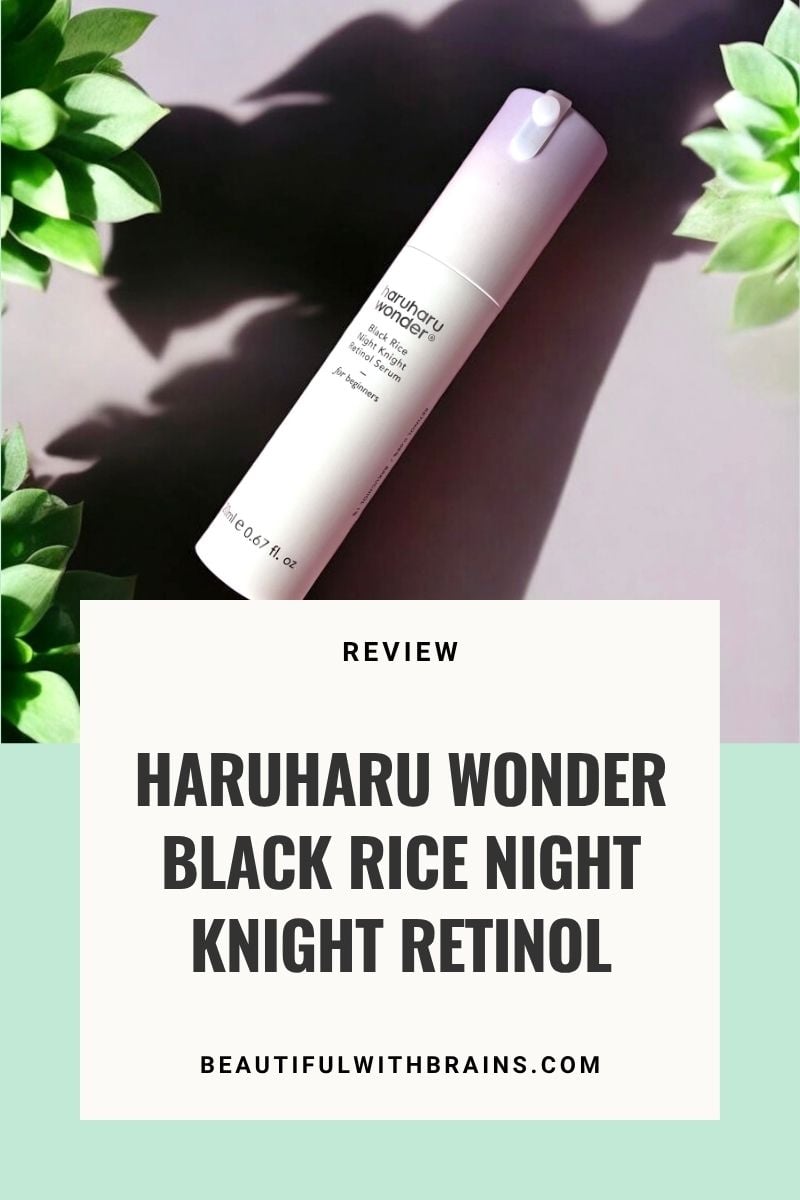
Is Haruharu Wonder Black Rice Night Knight Retinol the best Korean retinol for beginners? I must admit, I was hoping so. As a young girl, I’ve always dreamed of a knight in shiny armour come and take me away from the boring life in my small village. So the idea that my skin would have her own shining knight coming at night to rescue it is kinda cool. Can this night knight deliver on its promises though? I’ve put it to the test to find out. In this review, I’ll walk you through what this serum does, who should use it, and how to use it for best results:
- Key Ingredients In Haruharu Wonder Black Rice Night Knight Retinol: What Makes It Work?
- The Rest Of The Formula & Ingredients
- Texture
- Fragrance
- Packaging
- How To Use It
- Performance & Personal Opinion
- What I Like About Haruharu Wonder Black Rice Night Knight Retinol
- What I DON’T Like About Haruharu Wonder Black Rice Night Knight Retinol
- Who Should Use It?
- Does Haruharu Wonder Black Rice Night Knight Retinol Live Up To Its Claims?
- Price & Availability
- The Verdict: Should You Buy It?
Key Ingredients In Haruharu Wonder Black Rice Night Knight Retinol: What Makes It Work?
CAPRYLIC/CAPRIC TRIGLYCERIDE
This is refined coconut oil. The fatty acids that clog pores? Gone. What’s left is this light, silky oil that sits on your skin overnight and stops moisture from just evaporating off your face. It’s a great way to keep skin soft and moisturised for hours without adding more oils that could be problematic for some skin types.
BAKUCHIOL
A plant-based natural alternative to retinol. A study in the British Journal of Dermatology split 44 people into two groups: bakuchiol twice a day versus retinol once a day for 12 weeks. Both groups saw real reductions in fine lines and pigmentation, with barely any difference between them. The retinol group though? Way more stinging and flaking. The catch is 44 people is a tiny sample and 7 dropped out, so the honest takeaway is that the evidence looks promising but is still pretty limited in scale.
What’s also interesting is it’s not just doing the same thing as retinol through a different route. Both ingredients boost collagen production, but bakuchiol also has antioxidant activity that retinol doesn’t, and it triggers a skin-repair growth factor called FGF7 that retinol leaves completely alone.
Related: Should You Switch From Retinol To Bakuchiol?
RETINOL
If skincare had a GOAT, retinol would be it. When you apply this OTC form of Vitamin A, your skin converts it into retinoic acid, which then goes into your skin cells and changes how they behave at a gene level. More collagen, faster cell turnover, less collagen breakdown. Studies have shown topical retinol increases type I collagen, elastin, and fibronectin in the deeper layers of skin – and 0.4% retinol got results comparable to prescription-strength retinoic acid, without the brutal irritation that usually comes with it.
The side effects are real though: dryness, redness, and peeling in the first few weeks is genuinely common. It also makes your skin more sun-sensitive, which is why you use it at night and you absolutely do not skip SPF the next morning. This serum only has 0.08% retinol, which is an incredibly small concentration. It works SUPER SLOWLY. It’s also very gentle, so suitable for sensitive skin.
Related: Which Concentration Of Retinol Is Right For You?
The Rest Of The Formula & Ingredients
NOTE: The colours indicate the effectiveness of an ingredient. It is ILLEGAL to put toxic and harmful ingredients in skincare products.
- Green: It’s effective, proven to work, and helps the product do the best possible job for your skin.
- Yellow: There’s not much proof it works (at least, yet).
- Red: What is this doing here?!
- Water: The base everything else gets dissolved into.
- Hydrogenated Polyisobutene: t’s a synthetic oil that gives everything glide and also locks moisture into the skin surface.
- Glycerin: Pulls water up from inside your skin and grabs moisture from the air.
- Helianthus Annuus Seed Oil: Sunflower oil. High in linoleic acid, which is a fatty acid your skin barrier literally needs to function – and people with acne-prone or damaged skin are often low in it. Helps patch up your barrier without making you greasy.
- 1,2-Hexanediol: Hydrates a bit, but mainly it’s a stealth preservative booster that makes the other preservatives in the formula work harder so they need less of the harsh stuff.
- C14-22 Alcohols: Half of an emulsifier duo called Montanov L. Keeps the oil and water in this formula from separating into a gross mess.
- Potassium Cetyl Phosphate: The gold standard for hard-to-stabilise emulsions. Makes sense here because retinol is notoriously fussy to keep stable in a water-based cream.
- C12-20 Alkyl Glucoside: The other half of the Montanov L duo. Sugar-based emulsifier, keeps everything blended and helps the cream spread evenly when you apply it.
- Oryza Sativa Rice Extract: Rice extract packed with antioxidants including ferulic acid that protect your collagen from pollution and UV damage, and strengthens your moisture barrier.
- Arginine: Amino acid that’s mainly here to adjust the pH of the formula to something skin-friendly. But it also conditions the skin.
- Acrylates/C10-30 Alkyl Acrylate Crosspolymer: A synthetic polymer that thickens the texture and keeps the emulsion stable.
- Phyllostachys Pubescens Shoot Bark Extract: Bamboo extract. Has antioxidant and soothing properties from its flavones and phenolic acids.
- Disodium EDTA: Grabs rogue metal ions floating around in the formula (from the water, packaging, other ingredients) that would otherwise destabilise everything and make the product go off faster.
- Aspergillus Ferment: A fermented ingredient from the same fungus family that makes soy sauce and miso. It’s hydrating.
- Ethylhexylglycerin: Moisturises a tiny bit but mainly here to make the preservative system work better.
- Polyglyceryl-10 Stearate: A gentle plant-based emulsifier that helps keep everything blended and contributes to that non-greasy skin feel.
- Xanthan Gum: Natural thickener made by fermenting sugars. Also stabilises the emulsion.
- Adenosine: A molecule your body already naturally produces that supports collagen production.
- Hydrogenated Lecithin: Made of phospholipids, the same stuff your cell membranes are built from, so your skin basically recognises it. Forms tiny structures called liposomes that can wrap around active ingredients and carry them deeper through the skin barrier. Also, it moisturises skin.
- Glyceryl Stearate: Gentle emulsifier and emollient from glycerin and stearic acid. Keeps the formula blended, adds a soft skin feel, contributes to moisture retention.
- Polyglyceryl-2 Stearate: Another gentle plant-based emulsifier that keeps oil and water from separating and making the texture feel smooth.
- Ceramide NP: One of the ceramides that naturally lives in your skin barrier and strengthens its barrier.
- Dipropylene Glycol: Solvent and humectant. Dissolves other ingredients, draws some moisture to the skin, improves spreadability.
- Stearyl Alcohol: A fatty alcohol, thickens the cream and helps other ingredients penetrate skin better.
- Panax Ginseng Root Extract: Rich in antioxidants and ginsenosides that protect skin from environmental damage and support collagen production.
- Glucose: Simple sugar that acts as a humectant and helps feed the fermented ingredients in the formula.
- Hydroxyacetophenone: Phenolic antioxidant that neutralises free radicals both in the formula and on your skin, AND boosts the preservation system so gentler, lower amounts of traditional preservatives can do the job.
- Butylene Glycol: Humectant and solvent that hydrates, helps other ingredients spread and absorb, and has mild antimicrobial properties.
- Caprylyl Glycol: Moisturises a bit but mainly disrupts bacterial cell membranes to act as part of the preservation system.
- Cyclodextrin: It’s a ring-shaped sugar molecule with a hollow centre that physically traps the retinol molecule inside it, protecting it from degrading and releasing it slowly once it’s on your skin. Less irritation, more stability.
Texture
It looks and feels more like a lightweight lotion than a serum. But it’s quite runny and absorbs into your skin in seconds. It feels pleasant to apply and leaves no tackiness or greasy film behind. It basically looks like a lotion, but feels like a serum.
Fragrance
It’s fragrance-free, which is a point in its favour. Fragrance is one of the most irritating ingredients in skincare and has no place on your face. Unfortunately, in this case it also means you get to smell the raw ingredients… and it’s not the most pleasant thing in the world. It doesn’t stink, mind you. It has more of a herbal scent that’s just… a bit off, that’s all.
Packaging
It comes in a sleek white tube with purple accents and a pump applicator. This is the perfect packaging for retinol. This molecule slowly loses effectiveness when exposed to light and air, and this kind of tube prevents that from happening. The small size means it’s easier to travel with, which is always a plus. The downside? The pump tends to release a bit more product than you need, which isn’t ideal.
How To Use It
I recommend you use retinol serums every other night, right after cleansing and before any other product. The closer to your skin retinol is, the better it’s going to work. I usually also recommend you don’t use other actives, like exfoliants, on days you use retinol. Said that, this serum is so gentle, you could get away with using it more often – at least, if your skin is resilient. Although, in that case, I’d go with a higher concentration that gives you better results.
Performance & Personal Opinion
This is one of the utmost gentlest retinol serums on the market, which is both a good and a bad thing. Good because if your skin can’t tolerate retinol, this may just be the exception. Bad, because if it is so gentle even sensitive skin can tolerate it, you can’t expect to see a reduction in wrinkles anytime soon. I mean, retinol works even in tiny doses, but it does take MONTHS at this low concentration to see the smallest results. What you’ll see straight away is a subtle glow from the extra hydration. And frankly, I like that.
What I Like About Haruharu Wonder Black Rice Night Knight Retinol
- Lightweight, fast-absorbing texture
- Packaging keeps retinol stable and effective
- Feels hydrating on the skin
- Gives skin a lovely glow
- Gentle enough for sensitive skin
- Travel-friendly
What I DON’T Like About Haruharu Wonder Black Rice Night Knight Retinol
- Very low concentration of retinol, takes forever to see results
- Pump applicator releases a bit too much product
Who Should Use It?
I recommend it only to sensitive skin who can’t tolerate higher doses of retinol or newbies who are approaching retinol for the very first time. If you’re already a retinol user, this would be a downgrade.
Does Haruharu Wonder Black Rice Night Knight Retinol Live Up To Its Claims?
| CLAIM | TRUE? |
|---|---|
| A gentle yet effective retinol that’s beginner-friendly and sensitive-skin approved! | True. It takes ages to see results though. |
| Plant-powered: Combines microencapsulated retinol and, plant-based retinol alternative, bakuchiol, to minimize irritation while boosting efficacy | True. |
| Sensitive-skin friendly: Clinically tested formula to deliver results without the dreaded purge | True, but only because there’s so little retinol in it. |
| Wrinkle and pore care: Tightens pores and smoothes the appearance of fine lines | Retinol can indeed do this, but there’s so little of it, it takes months to see results |
| Maximized results: The airless pump maintains active ingredients’ potency and efficacy | True. |
| Boosts moisture: Ceramides and sunflower seed all provide effective hydration | True. |
Price & Availability
$22.00 at Anthropologie, Look Fantastic, Nordstrom, Stylevana, Target, and Yes Style
The Verdict: Should You Buy It?
It depends. If your skin is so sensitive, every retinol out there stings or burns, this could be worth a try. Still do a patch test first, as sensitive skin is so particular, you never know what may set it off. Everyone else, there are more powerful retinol serums around, even for first-timers.
Ingredients
Water, Caprylic/Capric Triglyceride, Hydrogenated Polyisobutene, Glycerin, Helianthus Annuus (Sunflower) Seed Oil, 1,2-Hexanediol, Bakuchiol, C14-22 Alcohols, Potassium Cetyl Phosphate, C12-20 Alkyl Glucoside, Oryza Sativa (Rice) Extract(2,000ppm), Arginine, Acrylates/C10-30 Alkyl Acrylate Crosspolymer, Phyllostachys Pubescens Shoot Bark Extract(1,000ppm), Disodium EDTA, Retinol(0.08%), Aspergillus Ferment, Ethylhexylglycerin, Polyglyceryl-10 Stearate, Xanthan Gum, Adenosine, Hydrogenated Lecithin, Glyceryl Stearate, Polyglyceryl-2 Stearate, Ceramide NP, Dipropylene Glycol, Stearyl Alcohol, Panax Ginseng Root Extract, Glucose, Hydroxyacetophenone, Butylene Glycol, Caprylyl Glycol, Cyclodextrin