
Last Updated on May 27, 2026 by Giorgia Guazzarotti
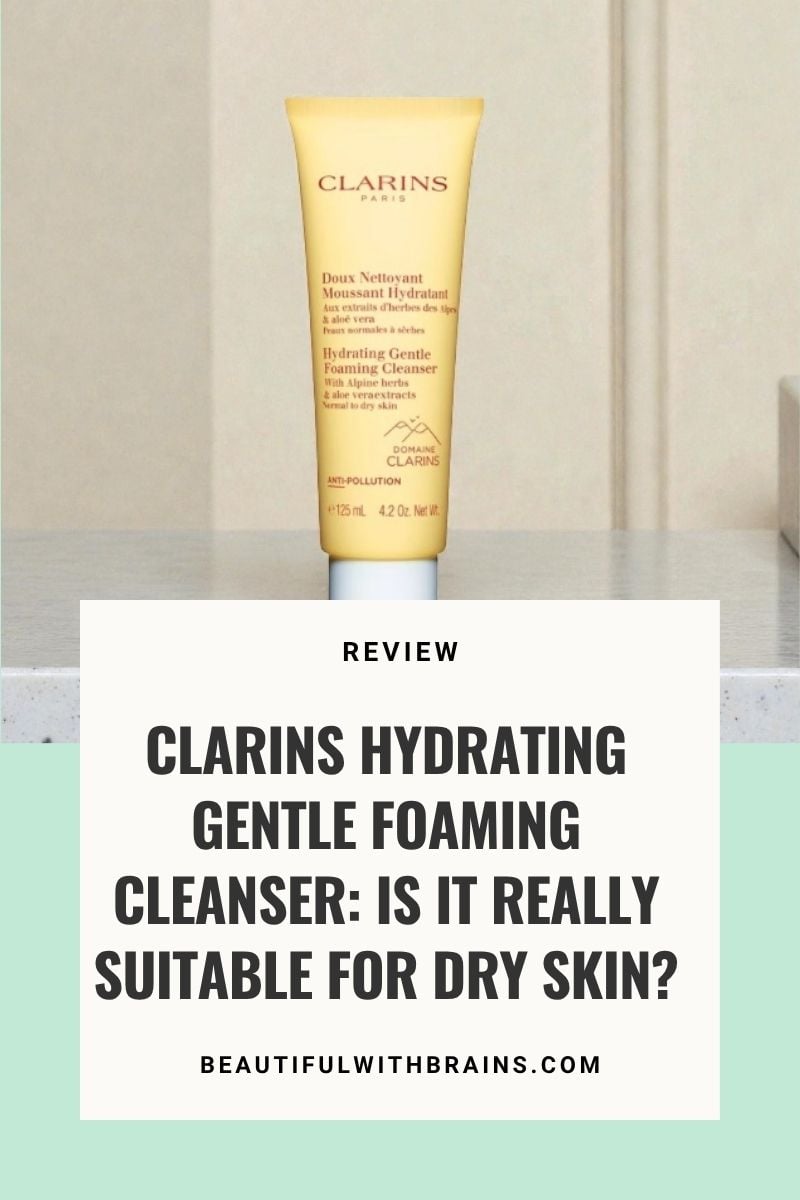
Foaming cleansers and dry skin are usually a match made in hell. Most of them strip the moisture barrier, leave your face feeling tight, and do absolutely nothing for your skin. So when Clarins Gentle Foaming Cleanser reviews started popping up with claims that this one is different – gentle enough for dry skin, hydrating even! – I had to put that to the test myself. I’m sceptical by default, but I’m also open to being wrong. In this review, I’m going to tell you whether this cleanser actually lives up to its promises or if it’s just clever marketing dressed in a soft lather.
- Key Ingredients In Clarins Hydrating Gentle Foaming Cleanser: What Makes It Work?
- The Rest Of The Formula & Ingredients
- Texture
- Fragrance
- How To Use It
- Packaging Of The Product
- Performance & Personal Opinion
- What I Like About Clarins Hydrating Gentle Foaming Cleanser
- What I DON’T Like About Clarins Hydrating Gentle Foaming Cleanser
- Who Should Use This?
- Does Clarins Hydrating Gentle Foaming Cleanser Live Up To Its Claims?
- Price & Availability
- The Verdict: Should You Buy It?
Key Ingredients In Clarins Hydrating Gentle Foaming Cleanser: What Makes It Work?
SURFACTANTS
Surfactants are what actually clean your skin. They have one end that attracts water, one that attracts oil – that’s how they grab dirt, excess oil, and makeup and rinse it away. Almost every cleanser has them. The question is just how harsh they are. Let’s take a closer look at the surfactants in this facial cleanser for dry and sensitive skin:
- Sodium Lauroyl Sarcosinate: an amino acid-based surfactant, so gentler than your average sulfate. This is doing most of the cleaning here. While it can still cause irritations, that’s rare.
- TIPA-Laureth Sulfate: Chemically milder than SLS, but still a sulfate, and the independent research on this specific one is thin. It’s probably here for foam.
- Sodium Cocoyl Glycinate: another amino acid surfactant, this one from glycine and coconut fatty acids. It softens the cleansing blend.
Two mild amino acid surfactants, one sulfate in the mix. Not a harsh formula, but not a purely gentle one either.
The Rest Of The Formula & Ingredients
NOTE: The colours indicate the effectiveness of an ingredient. It is ILLEGAL to put toxic and harmful ingredients in skincare products.
- Green: It’s effective, proven to work, and helps the product do the best possible job for your skin.
- Yellow: There’s not much proof it works (at least, yet).
- Red: What is this doing here?!
- Aqua/water/eau: The base everything else dissolves into, nothing more to say.
- Glycerin: A humectant that attracts water and holds it in the outer layers of your skin, so your barrier stays intact after washing and your face feels hydrated.
- Myristic acid: A fatty acid that reacts with the potassium hydroxide further down the list to create soap – that’s your lather and your cleansing right there. Also gives the formula that creamy texture.
- Palmitic acid: Same soap-building job as myristic acid, also adds mild emollient properties so your skin feels soft after rinsing instead of squeaky. Can clog pores, though rinse-off products are lower risk than leave-ons.
- Stearic acid: A fatty acid that acts as both an emulsifier and a mild conditioner. It holds the formula together and leaves skin feeling smooth.
- Potassium hydroxide: It’s just what makes the soap base work. It reacts with the fatty acids to actually create the cleansing part of the formula.
- Dimethicone: A silicone that gives the formula that smooth, silky feel during application and stops that tight uncomfortable sensation you sometimes get on rinse-off. Washes away cleanly, no build-up concern.
- Lauric acid: A fatty acid with mild antimicrobial properties that also contributes to foam and cleansing. A
- Glycol distearate: Purely what gives the cleanser that pearlescent shimmer when you squeeze it out.
- Glyceryl behenate: A fatty acid ester that works as both an emulsifier and an emollient – keeps the formula stable and contributes to that smooth, non-stripping feel on the skin.
- Propanediol: A humectant and solvent made from corn sugar that helps other ingredients distribute and absorb properly while adding a little hydration. B
- Cera microcristallina/microcrystalline wax: A refined mineral wax that gives the formula thickness.
- Parfum/fragrance: Makes it smell nice, but fragrance is one of the most common causes of contact dermatitis and skin sensitivity in cosmetics.
- CI 77891/titanium dioxide: Used as a white pigment to give the cleanser its bright appearance.
- Propylene glycol: A humectant and solvent that helps ingredients penetrate and keeps the formula stable
- Aloe barbadensis leaf juice powder: Powdered aloe vera with soothing, mildly anti-inflammatory properties.
- Tetrasodium EDTA: A chelating agent that binds to metal ions in the formula and in tap water to stop them interfering with how the surfactants work.
- Maltodextrin: A polysaccharide used as a carrier to stabilise the plant extracts in the formula.
- Moringa oleifera seed extract: Plant extract that has antioxidant properties.
- Melissa officinalis leaf extract: Lemon balm, with antioxidant and mild anti-inflammatory properties and some evidence for soothing irritated skin.
- Saponaria officinalis leaf extract: Soapwort extract, which contains natural saponins – gentle plant-derived cleansing compounds with a long history of use in skin cleansing.
- Alumina: Aluminium oxide used at low concentrations as a mild abrasive and texture-refining agent.
- Gentiana lutea extract: Yellow gentian root with antioxidant properties and some early evidence of anti-inflammatory and soothing activity.
- Citric acid: Used here as a pH adjuster.
- Sodium benzoate: A preservative that stops bacteria and fungi growing in the formula.
- Potassium sorbate: Another preservative, often paired with sodium benzoate because together they cover a broader spectrum of microbes.
- CI 19140/yellow 5: A synthetic dye that gives the cleanser its colour. Can irritate sensitive skin.
- CI 15985/yellow 6: Another synthetic dye fine-tuning the product’s colour. Same irritating caveat as yellow 5.
Texture
Creamy and thick straight out of the tube, like a rich lotion that somehow knows it’s a cleanser. You might squeeze out too much the first time because your brain expects it to behave like a gel or a traditional foaming wash, but this is much denser than that. A pea-sized amount is genuinely enough. Once you add water it transforms and lathers into a soft, silky foam that rinses away completely clean with no residue or film left behind.
Fragrance
It smells nice. There are floral and citrus notes (mandarin, neroli, something slightly herbal and green underneath) and it’s not aggressive. It dissipates quickly. During the wash it’s pleasant. By the time you’ve rinsed and patted dry, it’s basically gone. Here’s the thing though: fragrance in a skincare product doesn’t do anything good for your skin. It’s one of the most common culprits for contact dermatitis and irritations. For a gentle cleanser marketed specifically at dry and sensitive skin types, the decision to include it is a bit of a head-scratcher.
Related: Is Fragrance In Skincare As Bad As Paula Begoun Say?
How To Use It
You don’t need much product. Work a small amount (and I mean genuinely small, pea-sized) into your palms with a little water first to make it foam. Massage gently over a wet face, rinse thoroughly with lukewarm water, pat dry. You can use it bot morning and night. If you want to double cleanse, use it as a second wash, not a first wash.
Packaging Of The Product
This gentle foaming face cleanser comes in a squeeze tube with a flip cap. It’s sturdy enough, the opening is a reasonable size for controlled dispensing, and the tube doesn’t collapse awkwardly when it gets down to the last quarter. Clarins has reformulated the tubes to use lighter-weight materials with improved recyclable materials, which iI appreciate (even if the product itself is still plastic). The tube won’t win any design awards, but it travels well and the flip cap doesn’t pop open in a bag.
Performance & Personal Opinion
As a cleanser, it does its job without drama. That means without stripping skin’s natural moisture balance: your face is clean afterwards, there’s no skin’s barrier function damage, no dryness, no irritation for most people. Said that, if you’re wearing a full face of makeup a la Kardashians, this won’t be enough. Use this in the morning and an oil-based cleanser in the evening. But for normal to dry skin that isn’t acne-prone, this face wash is decent option. I say decent because it does the job, but I still prefer a cleansing milk for this skin type (especially one with less irritants). Glycerin is here to make the cleansing process gentler on your skin, so that once you wash it off, you’re left with soft skin. Oh, and the organic Alpine herbs sourced from their own farm don’t really purify skin. That’s just a buzzword that means nothing. No skincare ingredient can purify skin, so don’t fall for this kind of marketing!
What I Like About Clarins Hydrating Gentle Foaming Cleanser
- The creamy-to-foam texture is lathers and rinses completely clean with no residue
- Gentle, doesn’t strip sign of its moisture.
- A pea-sized amount cleans your whole face.
- Tube lasts for a long time.
- No post-wash tightness or that dry-paper feeling that ruins the rest of your routine.
What I DON’T Like About Clarins Hydrating Gentle Foaming Cleanser
- Fragrance in a product for dry and sensitive skin is a choice I can’t get behind.
- Contains comedogenic ingredients.
- Won’t shift heavy makeup or SPF as a standalone cleanser.
Who Should Use This?
Let’s see how this cleanser fares for different skin types:
- This works best for normal to dry skin that isn’t particularly reactive or acne-prone. If your skin feels tight after most cleansers, gets flaky in winter, and you want a daily wash that genuinely doesn’t make things worse – this will suit you.
- It’s not the right call for sensitive or reactive skin. The fragrance is the main reason. If your barrier is compromised, if you’re dealing with rosacea, eczema, or known fragrance sensitivity, there are better-formulated options that won’t ask you to take that risk.
- Not suitable for acne-prone skin, oily skin, and combination skin types due to comedogenic ingredients.
- Works best as a morning cleanser than as a makeup remover.
Does Clarins Hydrating Gentle Foaming Cleanser Live Up To Its Claims?
| CLAIM | TRUE? |
|---|---|
| Foaming cleanser for normal to dry skin that gently cleanses, softens, and hydrates. | True. |
| Gently washes away impurities, makeup, and pollution. | Mostly true. It’s not a match for heavy makeup. |
| Formulated with plant extracts sourced responsibly from Le Domaine Clarins, our open-air laboratory in the French Alps. | True. But just because they’re here, don’t expect them to do much. They just get rinsed off down the drain. |
| Preserves a healthy balance of the skin’s natural microbiota. | True. |
Price & Availability
$32.00 at Boots, Clarins, John Lewis, Nordstrom, Target, and Ulta
The Verdict: Should You Buy It?
Does it work? Yes. Is it worth the price? Not really, unless the experience of using it ( the texture, the scent, the ritual of it) genuinely adds something to your morning or evening. For dry, non-reactive skin that wants a daily cleanser that won’t cause problems, it’s a decent product. Just go in clear-eyed about what you’re buying.
List of Ingredients:
AQUA/WATER/EAU. GLYCERIN. MYRISTIC ACID. PALMITIC ACID. STEARIC ACID. POTASSIUM HYDROXIDE. DIMETHICONE. LAURIC ACID. SODIUM LAUROYL SARCOSINATE. GLYCOL DISTEARATE. GLYCERYL BEHENATE. PROPANEDIOL. TIPA-LAURETH SULFATE. SODIUM COCOYL GLYCINATE. CERA MICROCRISTALLINA/MICROCRYSTALLINE WAX/CIRE MICROCRISTALLINE. PARFUM/FRAGRANCE. CI 77891/TITANIUM DIOXIDE. PROPYLENE GLYCOL. ALOE BARBADENSIS LEAF JUICE POWDER. TETRASODIUM EDTA. MALTODEXTRIN. MORINGA OLEIFERA SEED EXTRACT. MELISSA OFFICINALIS LEAF EXTRACT. SAPONARIA OFFICINALIS LEAF EXTRACT. ALUMINA. GENTIANA LUTEA EXTRACT. CITRIC ACID. SODIUM BENZOATE. POTASSIUM SORBATE. CI 19140/YELLOW 5. CI 15985/YELLOW 6 [V4329A]